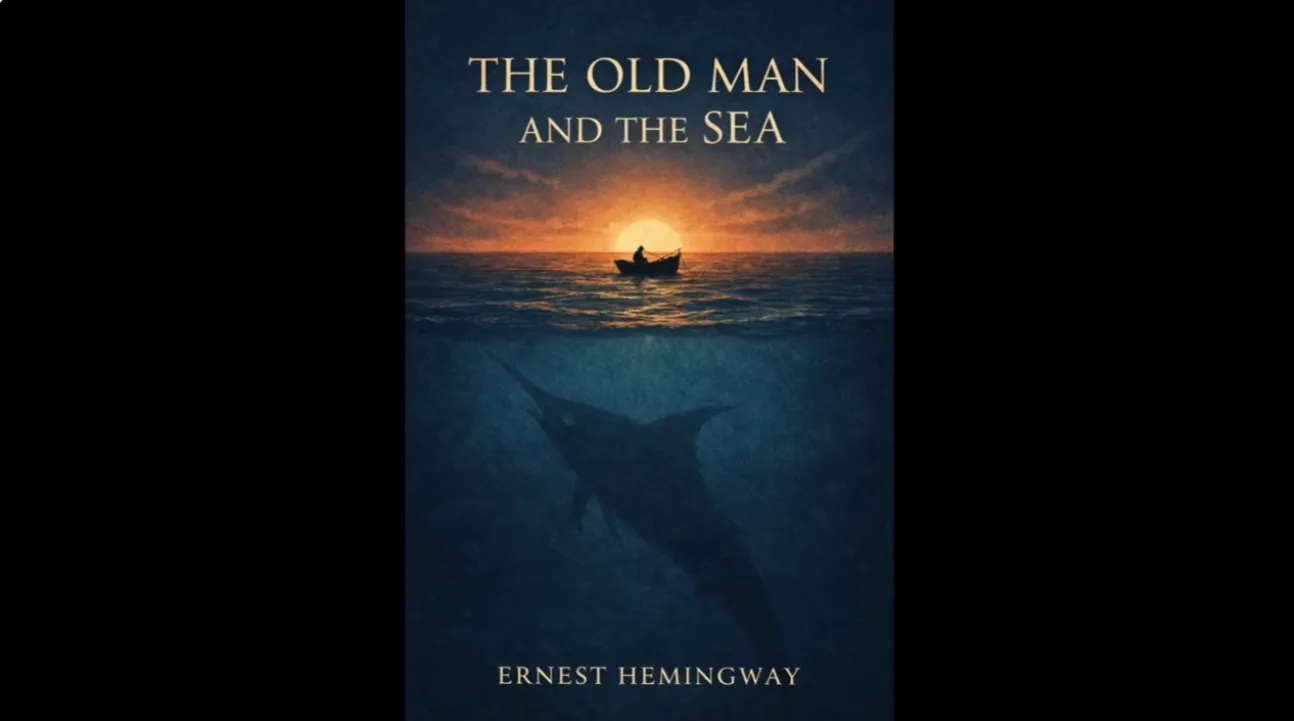
How Hemingway makes us hear the speed, weight and power of a great fish hidden beneath the ocean.
The Power of Sound in Writing
You do not simply read a great book. You hear it.
Reading may appear silent, but the best books create an entire soundscape inside the imagination. A distant train, a ticking clock, a humming city or the snap of a pencil can establish place, pace and emotion before the action begins.
Sound can also reveal something hidden from sight.
Shirley Jackson makes an unseen house knock. Harper Lee tracks an approaching attacker through footsteps. Tolkien gives fate the beat of a drum. John Wyndham’s plants communicate by clattering, Cormac McCarthy closes the door on a life with a click, and Hilary Mantel turns whispers into political intelligence.
Ernest Hemingway takes us onto the open ocean.
There are no corridors to produce echoes, no walls concealing listeners and no city noise to fill the background. There is only an old man, a small wooden skiff, a fishing line and an enormous creature moving beneath the surface.
Santiago cannot always see the marlin.
But he can hear it.
More importantly, he can feel what it is doing through the line connecting them.
Hemingway and The Old Man and the Sea
Published in 1952, The Old Man and the Sea follows Santiago, an ageing Cuban fisherman who has gone eighty-four days without catching a fish.
On the eighty-fifth day, he sails alone far into the Gulf Stream.
A giant marlin takes his bait.
The fish is too powerful for Santiago to pull aboard. Instead, it tows his boat across the ocean for days. The struggle becomes a test of endurance between two living creatures linked by a thin fishing line.
Santiago comes to admire the marlin. He recognises its strength, dignity and determination. He even calls it his brother.
Yet he remains committed to killing it.
The contest is both physical and intimate. Santiago learns about the fish through every change in the angle, speed and tension of the line.
It becomes a form of communication.
Hearing What Cannot Be Seen
Much of the marlin’s struggle takes place beneath the surface or in darkness.
Santiago cannot simply watch the fish and judge what it intends to do. He must interpret indirect signals.
The line races through his hands.
The boat changes direction.
The wood takes the strain.
The water breaks somewhere beyond his vision.
Hemingway writes:
“He could not see the fish’s jumps but only heard the breaking of the ocean and the heavy splash as he fell.”
The sentence forces Santiago—and the reader—to construct the action acoustically.
We hear the surface rupture.
We hear the marlin’s body return to the sea.
From the weight of the splash, we imagine its size.
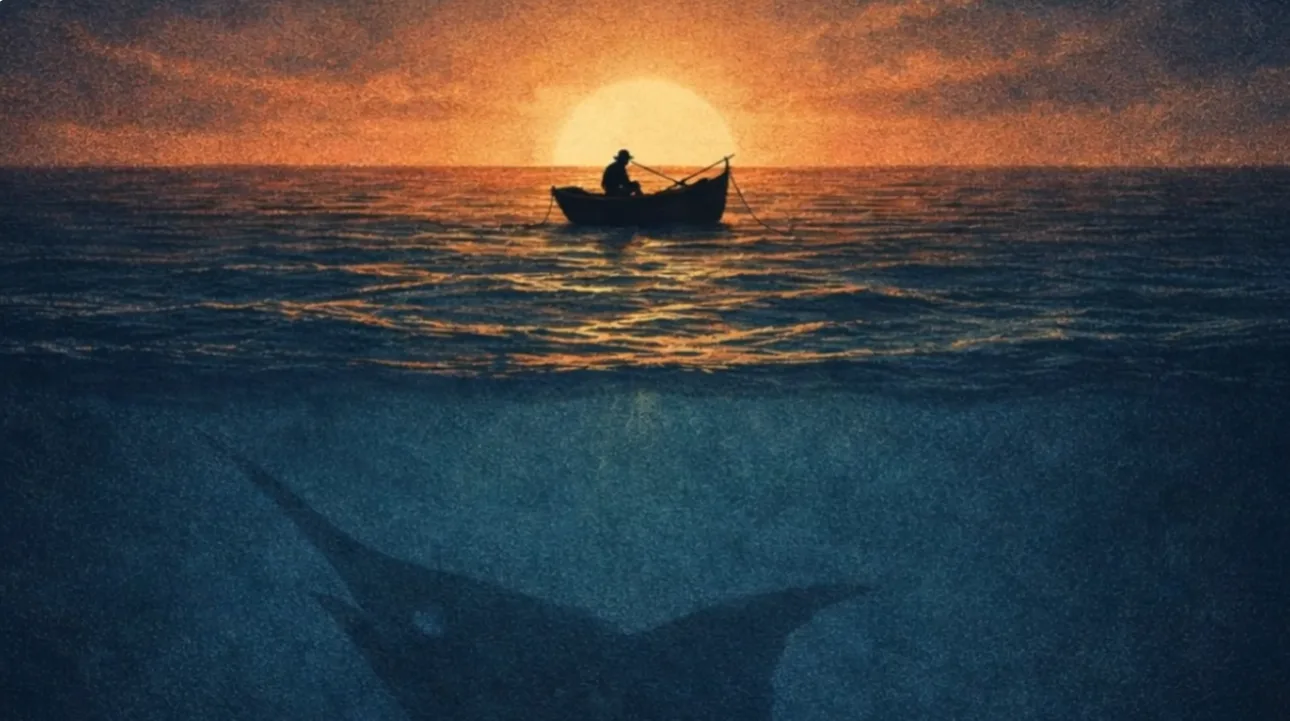
Hemingway does not need to pause and tell us that the fish is enormous.
The ocean tells us.
The Trick: Arrange Sounds as Actions
The strength of the passage comes from sequence.
First, the fish rises.
The ocean breaks.
Then the marlin falls.
The water receives its weight in a heavy splash.
Each sound marks a separate stage of movement. We do not hear random commotion; we hear a physical event unfolding.
This distinction matters.
A list of noises can decorate a scene. A sequence of noises can narrate one.
Consider:
A crash and a shout came from the next room.
Now compare it with:
Glass shattered. A chair struck the floor. Then someone shouted.
The second version creates an order. The reader begins imagining what happened and perhaps who caused it.
Hemingway’s sound sequence works the same way. The movement is concealed, but its sounds allow us to reconstruct it.
The Fishing Line Has a Voice
The fishing line is the physical connection between Santiago and the marlin.
It tightens, races, cuts and changes angle. Every movement carries information from the fish’s body into the fisherman’s hands.
Santiago does not need a modern instrument to measure speed or pressure. His body performs that work.
He feels the strain across his back.
He judges the fish through his injured hands.
He knows when to give line and when to increase the pressure.
The line effectively speaks through tension.
This is sound writing at its most physical. Hemingway does not isolate hearing from the other senses. Sound, touch, pain and movement operate together.
The line races audibly, but its speed is also felt as heat and injury.
The fish’s splash is heard, while the boat registers its power.
Santiago is not observing the struggle from a distance.
He is wired directly into it.
Sound Reveals Size
A hidden object becomes imaginable through the effect it has on its surroundings.
A small fish might disturb the water.
A great marlin seems to break the ocean.
That verb gives the sound scale. The surface does not merely splash; it appears to rupture under the animal’s force.
Then comes the heavy fall.
Weight cannot literally be heard, yet readers recognise its acoustic evidence. A pebble and a boulder make different sounds when they strike the ground. A child and a large man move differently across a wooden floor.
Hemingway trusts the reader’s physical memory.
We have all heard objects hit water. We instinctively understand what a heavier impact sounds like.
The splash becomes a measurement.
The Ladder of Intensity
Hemingway increases intensity without abandoning simplicity.
A movement begins beneath the surface.
The line accelerates.
The ocean breaks.
The fish falls.
The splash confirms its mass.
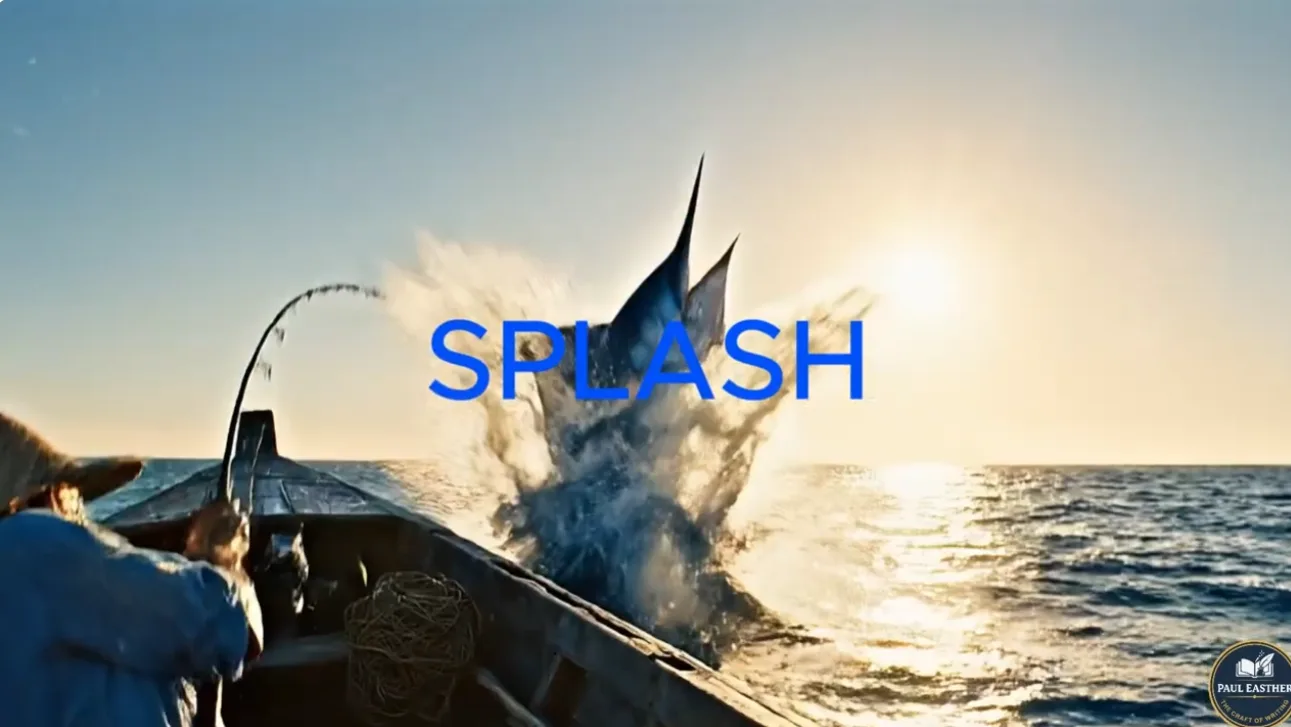
Each stage is stronger than the last. The action climbs from pressure to speed, from speed to emergence and from emergence to impact.
This creates a ladder of intensity.
Writers often attempt to increase drama by adding adjectives. A sound becomes loud, then very loud, then deafening.
Hemingway intensifies the scene through changing actions instead.
The line does one thing.
The ocean does another.
The fish completes the sequence.
The nouns and verbs carry the force.
The Ocean Is Not Silent
The open sea may appear empty, but Hemingway fills it with small, meaningful sounds.
Water moves against the skiff. Line passes through Santiago’s hands. Flying fish break the surface. Birds call above him. The structure of the boat responds to strain.
These noises help establish Santiago’s isolation.
There are no nearby human voices to interpret events for him. Every sound belongs to the natural world or to the fragile equipment keeping him connected to it.
He must listen because mistakes have consequences.
A change in the line might signal that the fish is rising, circling, resting or preparing another run. Sound is not atmosphere added after the action.
It is part of Santiago’s working knowledge.
The experienced fisherman hears information that another person might dismiss as noise.
The Feeling: The Living Line
Hemingway’s technique creates what we might call the Living Line: the sensation that two distant bodies are communicating through tension, vibration and sound.
Santiago cannot always see the marlin, but he is never entirely separated from it.
The line carries the fish’s resistance into his body.
It tells him the marlin is alive.
It also tells the marlin that Santiago is still holding on.
The struggle therefore becomes a silent conversation conducted through force. Each participant learns about the other through pressure and response.
Pull.
Yield.
Run.
Hold.
Neither can escape without breaking the connection.
Restraint Makes the Sound Larger
Hemingway’s prose is famously economical. He does not smother the action beneath elaborate description.
That restraint makes the sounds more prominent.
A simple word such as splash may appear ordinary, but its placement after sustained tension gives it force. By the time the fish breaks the surface, the reader has spent so long imagining what lies beneath that the impact feels enormous.
The sound inherits power from anticipation.
This offers writers an important lesson: intensity is not always created at the moment of impact.
It can be accumulated beforehand.
The longer something remains hidden, the more forcefully its first sound can enter the scene.
What Writers Can Learn from Hemingway
When a character cannot see something important, let sound reveal its physical properties.
Ask:
Does it move quickly or slowly? Is it light or heavy? How does the environment respond to it? Can vibration travel through a floor, wall, rope or tool? What does an experienced character understand from the sound? Can several sounds reveal consecutive stages of movement?
Avoid explaining everything immediately.
Let the reader hear the evidence and construct the hidden action.
Also consider connecting sound with touch. A vibration through wood or tension through rope can make an unseen force feel physically present.
The character does not simply hear the event.
Their body becomes part of it.
Try It Yourself
Write a scene in which a character is connected to something they cannot see.
Use a rope, cable, fishing line, pipe or wall.
Introduce three signals in sequence.
First, a quiet vibration.
Then rapid movement.
Finally, an impact that reveals the hidden object’s weight.
Do not describe the object directly. Allow the character to judge its size and intention entirely through what they hear and feel.
Your objective is to make the reader imagine something enormous before it comes into view.
Hemingway shows us that a writer does not need to place the whole marlin above the surface.
The racing line, the breaking ocean and one heavy splash are enough.
This is the seventh article in the Stop Writing in Silence series.