
The most frightening voice in Orwell’s world is the one nobody can switch off.
The Noise of Power
You do not simply read a great book. You hear it.
Throughout this Stop Writing in Silence series, we have heard houses bang, footsteps approach, mountains tremble, plants clatter, weapons click, courtiers whisper, marlins strike the water and travelling fairs announce the arrival of miracles.
George Orwell gives us something colder.
In Nineteen Eighty-Four, sound is not merely part of the atmosphere. It is part of the government.
The citizens of Oceania live beneath a continuous barrage of announcements, patriotic music, production figures, military reports, shouted commands and manufactured hatred. The Party does not wait for people to listen. Its voice enters their homes and workplaces through the telescreen.
Silence has become suspicious.
Privacy has become impossible.
And the soundscape itself teaches the population who possesses the right to speak.
A Voice Inside the Room
Published in 1949, Nineteen Eighty-Four follows Winston Smith, a minor Party worker living under the rule of Big Brother.
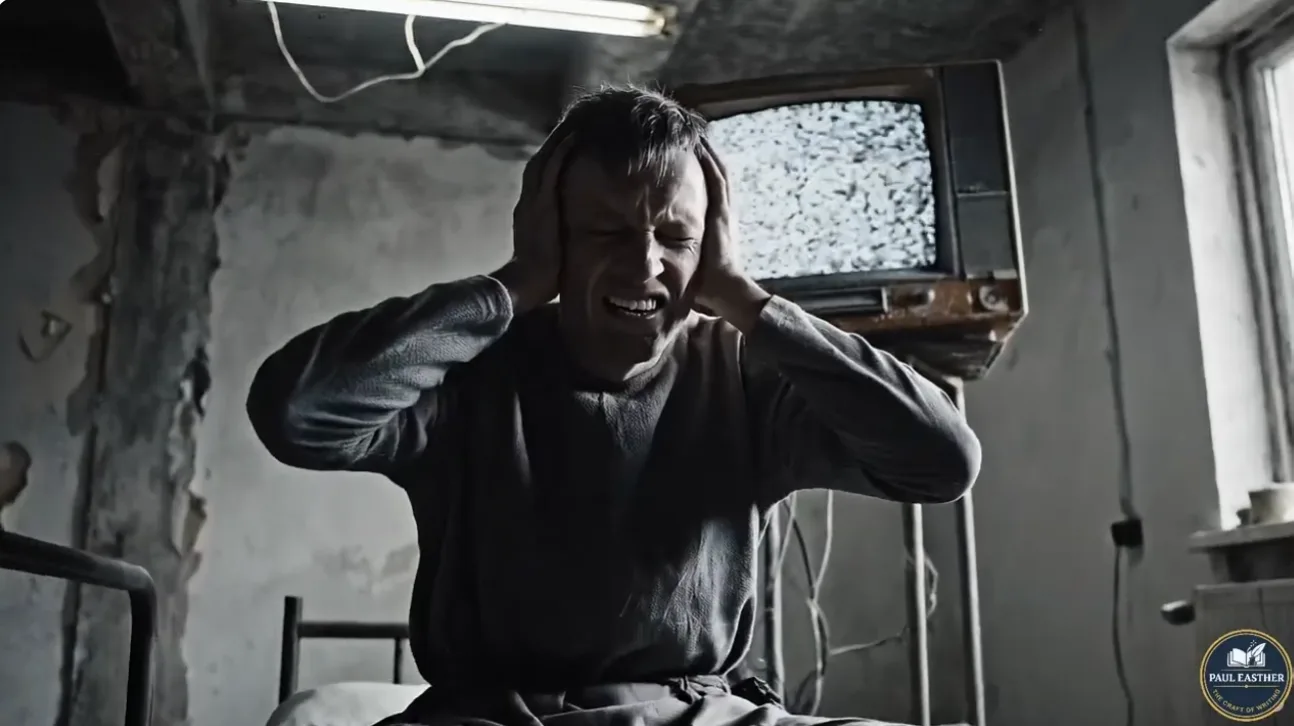
Winston’s apartment contains a telescreen: a metal device that broadcasts propaganda while simultaneously watching and listening to him.
He can reduce its volume.
He cannot turn it off.
That small distinction creates the entire psychological atmosphere of the novel. The telescreen is not an object Winston chooses to use. It is a presence imposed upon him.
A normal radio stops when the listener has heard enough. A normal television permits the viewer to leave the room. The telescreen destroys that relationship. It decides when communication begins, how loudly it speaks and when Winston must pay attention.
Winston is not its audience.
He is its captive.
The Correct Sound of the Boots
The quotation in the original video combines several different sound details from the novel. Orwell does not write:
“The grating voice of the telescreen and the heavy tramp of boots in the street below.”
The underlying idea is right, but the sentence itself does not appear in the book.
A genuine passage during the Two Minutes Hate gives us something even more revealing:
“The dull rhythmic tramp of the soldiers’ boots formed the background to Goldstein’s bleating voice.”
Notice how carefully Orwell constructs that sound.
The boots are dull. They possess no sparkle, variation or humanity.
They are rhythmic. Individual footsteps have merged into a single collective beat.
And they form the background to a voice being presented as contemptible and dangerous.
The sound is part of a propaganda performance. Goldstein’s voice is described as “bleating,” reducing him to a weak and ridiculous animal. Behind him march endless ranks of identical soldiers.
The message does not need to be spoken directly.
One sound represents weakness.
The other represents irresistible force.
When People Become a Rhythm
A single footstep belongs to a person.
The tramp of hundreds of boots belongs to a system.
That is why massed footsteps appear so often in stories about armies, prisons and authoritarian governments. Once individual movements lock into the same rhythm, we stop hearing separate human beings. We hear a mechanism.
Orwell exploits that transformation.
The soldiers on the telescreen have faces, uniforms and bodies, but the sound strips away their individuality. They become a repeated impact: boot, ground, boot, ground.
The rhythm tells us that another soldier will always follow the one before him.
It suggests discipline without reflection and movement without choice.
More importantly, it makes the military seem endless. The screen can replace one row of soldiers with another, but the tramp never needs to stop.
This is oppression expressed as percussion.
The Telescreen Barks
Orwell frequently gives the telescreen the behaviour of an aggressive animal.
It does not politely request compliance. It barks.
That verb matters.
A bark is abrupt, loud and difficult to ignore. It carries command even before the listener understands its meaning. The body reacts first: muscles tighten, attention snaps towards the source and disobedience suddenly feels dangerous.
By making the machine bark, Orwell gives it both mechanical reach and animal hostility.
The telescreen can also alter its tone. It announces statistics triumphantly, delivers military news gravely and erupts without warning when somebody attracts its attention.
The Party’s voice is therefore everywhere but emotionally empty. Its excitement, anger and solemnity are produced on command.
It does not express feeling.
It manufactures feeling in other people.
Propaganda as a Soundtrack
The Two Minutes Hate demonstrates this process at its most concentrated.
The citizens gather before a screen. Goldstein appears as the official enemy. His voice is presented as irritating and absurd. Soldiers march behind him. People begin shouting at the image.
Within seconds, the room fills with rage.
Orwell shows that propaganda does not operate only through arguments. It works through repetition, tempo, volume and emotional contagion.
The crowd hears other people shouting, so shouting feels natural.
The military rhythm creates urgency.
The enemy’s voice is made deliberately unpleasant.
The broadcast supplies a target, and the surrounding noise tells everyone how they are expected to respond.
Before long, nobody can distinguish a private reaction from the emotion imposed upon the room.
The soundscape has done the thinking for them.
The Sound of Someone Coming
Later, after Winston has been arrested, boots acquire another meaning.
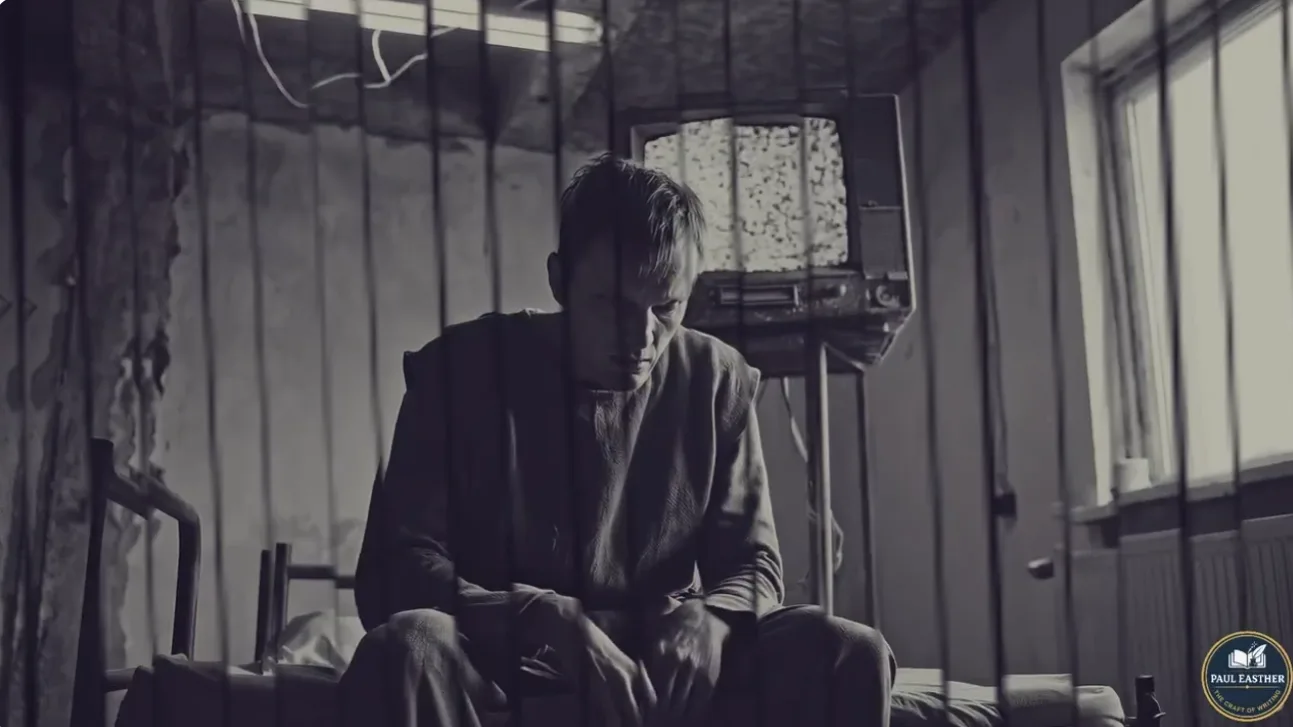
In the prison cells of the Ministry of Love, he repeatedly hears guards approaching outside. Every footstep might announce another prisoner’s removal—or his own.
At one point, the narration tells us:
“Soon, very soon, perhaps in five minutes, perhaps now, the tramp of boots would mean that his own turn had come.”
The boots are frightening because Winston cannot see who is coming.
Sound travels through the door before knowledge does.
He hears the approach but does not know its destination. That uncertainty forces his imagination to complete the journey. Each step increases the possibility that the guards will stop outside his cell.
Orwell turns an ordinary corridor into an instrument of torture.
The guards do not need to threaten Winston directly. Their boots do it for them.
Mechanical Sounds and Human Sounds
The Party’s world is filled with hard, repetitive noises:
Boots tramp.
Doors clang.
Telescreens bark.
Machines dictate.
Sirens announce.
Crowds chant.
Against them, Orwell places quieter human sounds: whispers, memories, birdsong and private conversation.
When Winston imagines safety, he does not dream of absolute silence. He imagines gentle domestic noises—the singing of a kettle and the friendly ticking of a clock.
That contrast is crucial.
Orwell is not suggesting that noise itself is evil. He distinguishes between sounds that accompany human life and sounds designed to dominate it.
A kettle sings without issuing an order.
A clock ticks without reporting Winston to the Thought Police.
Birdsong exists without political meaning.
These modest sounds represent a world in which objects do not watch people and voices do not automatically demand obedience.
The Destruction of a Private Voice
The greatest threat in Nineteen Eighty-Four is not that the Party speaks loudly.
It is that nobody else can speak safely.
Winston must keep his voice below the level the telescreen can detect. He writes in a diary because spoken dissent would immediately expose him. Even facial expressions can betray thoughts that language has concealed.
The Party fills the public soundscape while forcing the individual voice into a whisper.
That is how Orwell makes surveillance audible.
The citizen hears authority everywhere but cannot risk answering honestly. Communication becomes one-way. The state broadcasts; the population absorbs.
Eventually, the external voice begins to replace the internal one.
A person no longer asks, “What do I believe?”
They ask, “What am I permitted to believe?”
The final conquest occurs when the Party’s language becomes the voice inside the prisoner’s own mind.
What Writers Can Learn from Orwell
If you are writing about power, ask who controls the soundscape.
Who is allowed to speak loudly?
Who must whisper?
Which sounds can be stopped, and which must be endured?
Does an approaching character have a recognisable footstep? Does a machine issue gentle reminders or sharp commands? Does an institution fill every pause with announcements because silence might allow people to think?
You can also create authority through repetition.
One command may be ignored.
The same command repeated from every wall becomes an environment.
Likewise, an unseen threat can be made more frightening through sound than through immediate description. Allow the reader to hear the lift stop, the boots enter the corridor and the keys move outside the door.
Delay the arrival.
Let every noise narrow the possible escape.
Try It Yourself
Write a scene in which a character sits alone in a room containing a speaker they cannot switch off.
Begin with harmless information: the time, the weather or a public announcement.
Then repeat the message.
On each repetition, change one element. Increase the volume. Remove a friendly word. Add the character’s name. Mention something they did earlier that day.
Do not introduce a guard or visible enemy.
Let the voice alone reveal that the character is being watched.
Then place one quiet human sound beneath the broadcast—a breath, a pencil scratching or fingers tapping nervously against wood.
The conflict between those two sounds will tell the reader who has power and who is struggling to remain an individual.
The Machine Never Stops Speaking
Orwell’s Oceania is terrifying because oppression is not confined to prisons or interrogation rooms.
It is present in the ordinary background of life.
It marches behind the news.
It barks from the wall.
It approaches through the corridor.
It fills the space where private thought might otherwise grow.
The repeated sound of boots transforms people into machinery, while the telescreen transforms speech into occupation. Together they create a world in which the state does not merely control what citizens do.
It controls what they hear while doing it.
And when one voice is allowed to speak without ever being silenced, every other voice eventually learns to whisper.
This is the ninth article in the Stop Writing in Silence series.