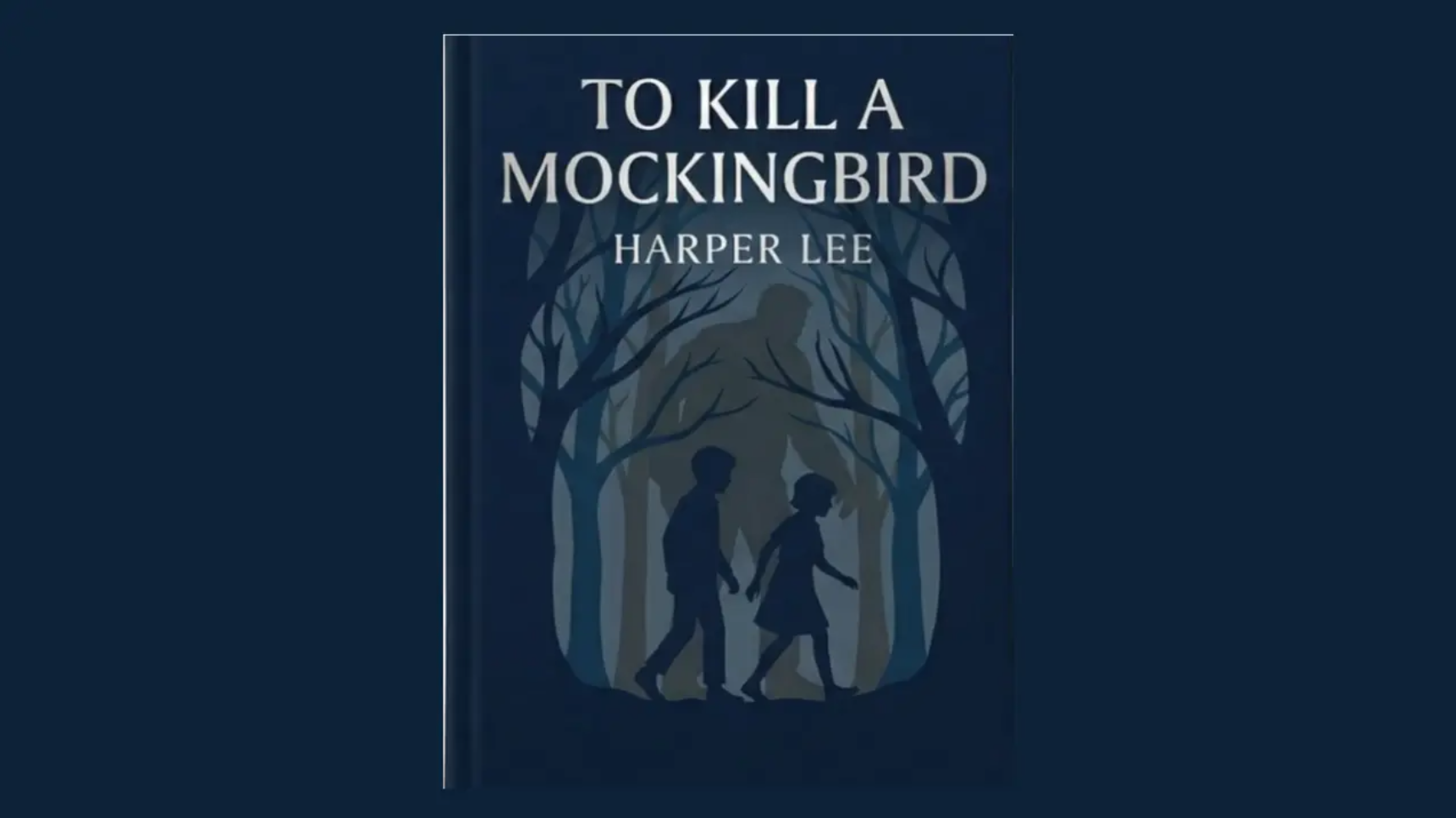
How Harper Lee makes footsteps in the darkness reveal the distance, movement and intention of an unseen threat.
The Power of Sound in Writing
You do not simply read a great book. You hear it.
Reading may look like a silent activity, but the best books create an entire soundscape inside the imagination. A distant train, a humming refrigerator or a pencil snapping between someone’s fingers can tell us where we are and how we should feel before the action begins.
Sound can establish safety, quicken the pace or warn us of danger. It can also reveal something that neither the character nor the reader can see.
Shirley Jackson used pounding and silence to make Hill House itself feel alive.
Harper Lee gives sound a different purpose.
In To Kill a Mockingbird, sound becomes a primitive warning system. It allows two children walking through darkness to measure the diminishing distance between themselves and someone following them.
The frightening part is not merely that they hear footsteps.
It is that the footsteps change.
Harper Lee and To Kill a Mockingbird
Published in 1960, To Kill a Mockingbird is narrated by Scout Finch as she remembers her childhood in the fictional Alabama town of Maycomb.
Scout and her brother Jem have spent much of the novel trying to understand the bewildering adult world around them. They witness courage and cruelty, kindness and prejudice, justice and its failure.
During the novel’s climax, they are returning home at night after a Halloween pageant. Scout is still trapped inside an awkward ham costume made from chicken wire and cloth. Her vision is badly restricted.
Lee deprives her young narrator of the sense readers normally depend upon most.
Scout cannot see what is behind her.
She can only listen.
The Sound of Being Followed
At first, Scout and Jem hear movement behind them. It appears to stop when they stop and resume when they begin walking again.
They try to explain it away. Perhaps it is another child attempting to frighten them. Perhaps the sound belongs to someone they know.
But the noises continue.
The person behind them drags or shuffles his feet as though wearing heavy shoes. Scout initially mistakes the rustling of his clothing for trees moving in the night. Gradually, the repeated sound becomes recognisable as the soft friction of cotton rubbing against cotton.
The children cannot identify the follower’s face.
They can identify his rhythm.
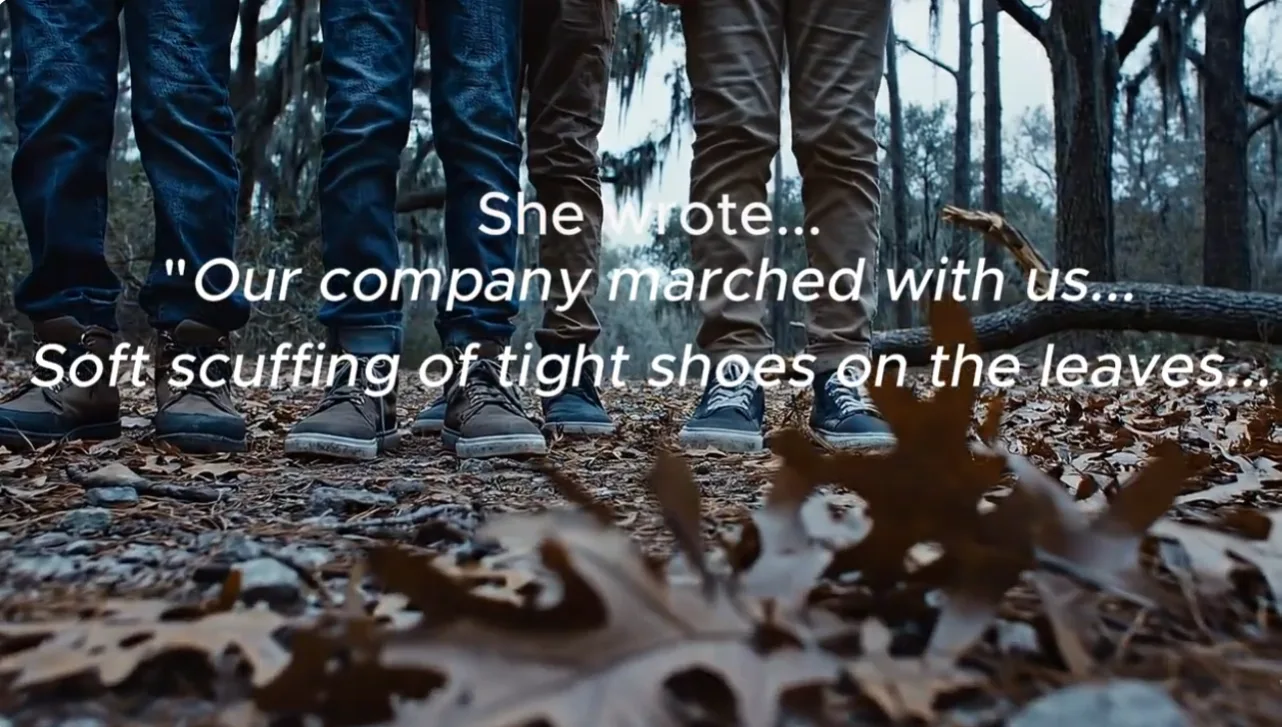
This transforms a vague noise into evidence.
The footsteps stop when the children stop.
That means someone is listening to them.
The movement resumes when they walk.
That means someone is matching their pace.
The sound is no longer part of the landscape. It belongs to a conscious presence that is adjusting its behaviour in response to theirs.
The Trick: Turn Sound into Movement
Lee does not need to tell us that the follower is drawing closer. She lets changes in sound communicate his movement.
“His trousers swished softly and steadily. Then they stopped.”
The sentence is frightening because of its simplicity.
Softly and steadily creates a predictable rhythm. For a moment, that rhythm allows Scout—and the reader—to track the person behind her.
Then it stops.
The silence does not mean that the danger has disappeared. It means the children have lost their ability to locate it.
Immediately afterwards, the follower begins running towards them.
Lee changes the rhythm of the prose along with the rhythm of the pursuit. The scene moves from careful listening to sudden panic. Observation becomes action.
Quiet footsteps become an attack.
Sound Measures Distance
Writers often use sound to establish atmosphere: rain against a roof, music through an open window or traffic beyond a bedroom wall.
Lee uses it more precisely.
Sound becomes a measuring instrument.
A faint noise suggests distance. A clearer one suggests proximity. Repetition establishes direction, while increasing speed signals urgency.
The children do not need to see their pursuer to understand that he is approaching. Every scuff and swish places him more accurately in the darkness.
This is particularly effective because Scout’s bulky costume restricts both her vision and movement. She is forced to depend on a sense that cannot tell her everything.
Sound reveals that someone is present—but not who he is.
It reveals movement—but not his expression.
It reveals the pursuit—but not how she can escape it.
Lee gives Scout enough information to be afraid but not enough to feel in control.
Misheard Sounds Create Discovery
One of the cleverest elements in the scene is Scout’s initial misunderstanding of what she hears.
She thinks the rustling comes from trees. Then she recognises the softer, more regular sound of fabric moving with each step.
This correction creates a small but disturbing revelation.
The environment has not suddenly become dangerous. The danger was already present, disguised as an ordinary part of the environment.
This technique is enormously useful to writers.
A character might mistake breathing for wind beneath a door. A clicking lock might initially sound like a cooling pipe. A second pair of footsteps could hide inside the rhythm of the character’s own.
The revelation works because the sound has been heard twice:
First as something harmless.
Then as what it truly is.
Nothing about the noise needs to grow louder. Only its meaning changes.
Silence Removes Certainty
As in Shirley Jackson’s Hill House, silence plays an active role in Lee’s scene.
When the footsteps continue, Scout can track them. When they stop, she loses that certainty.
The reader instinctively understands the danger of this silence. The follower might be standing still. He might be changing direction. He might already be much closer than Scout realises.
Silence conceals movement.
That is why an interrupted sound can be more frightening than a continuing one. A steady noise lets us construct a mental map. Its disappearance destroys that map.
The darkness has not changed.
Our knowledge of what occupies it has.
The Feeling: The Closing Distance
Lee’s technique creates what we might call the Closing Distance: the sensation that an unseen threat is steadily reducing the space between itself and the character.
The reader does not merely know that Scout and Jem are being followed. We participate in their calculations.
Was that sound closer?
Did it stop when they stopped?
Is it still behind them?
When the follower breaks into a run, the questions end. The children no longer need to interpret the sound because its intention has become unmistakable.
This progression—from hearing, to suspicion, to recognition, to flight—makes the scene feel immediate. The reader’s attention narrows until every small noise matters.
The story has taught us to listen for danger.
Then it sends danger running towards us.
What Writers Can Learn from Harper Lee
To make sound suspenseful, connect it to movement.
Ask:
Is the sound approaching or retreating? Does it stop when the character stops? Does its rhythm suggest walking, running or waiting? Can the character identify its source? * Could an innocent sound be concealing something dangerous?
Avoid immediately naming whatever produces the noise. Let the character hear it, interpret it and perhaps interpret it incorrectly.
Then change one quality.
Alter its speed.
Move it closer.
Interrupt its rhythm.
Allowing the character to recognise what the sound means can be more frightening than simply announcing what made it.
Try It Yourself
Write a character walking alone at night.
Give the setting a natural rhythm: the character’s footsteps, the movement of their clothing or the click of something they are carrying.
Now introduce a second sound that almost matches the first.
Let the character stop.
The second sound stops a fraction too late.
Have the character begin walking again, slightly faster. Allow the other rhythm to return.
Do not reveal who—or what—is responsible.
Concentrate on the shrinking distance between the sounds.
Harper Lee shows us that darkness does not have to leave a character completely helpless. Sound supplies fragments of information—but never quite enough.
A character may not be able to see danger approaching.
Unfortunately, they can hear it keeping pace.
This is the second article in the Stop Writing in Silence series.