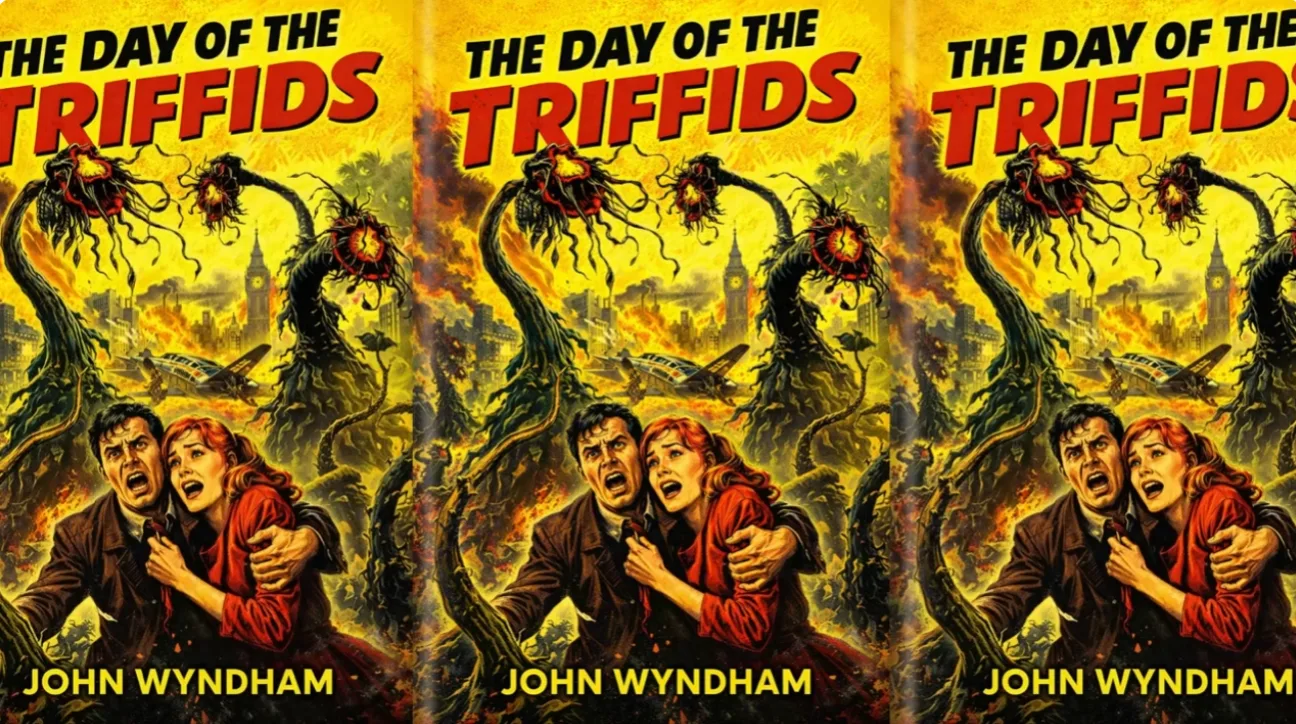
How John Wyndham gives walking plants an inhuman language—and turns an ordinary garden sound into a warning of coordinated attack.
The Power of Sound in Writing
You do not simply read a great book. You hear it.
Reading may appear silent, but the best books create an entire soundscape inside the imagination. A distant train, a ticking clock, a humming city or the snap of a pencil can establish place, pace and emotion before the action begins.
Sound can also give a voice to something that should not possess one.
Shirley Jackson makes an unseen house knock. Harper Lee allows footsteps to measure the distance to an attacker. J.R.R. Tolkien turns a drumbeat into a prophecy of doom.
John Wyndham does something stranger.
He creates a living enemy that cannot roar, growl or speak. The triffids communicate—or appear to communicate—by striking hard sticks against their own stems.
They clatter.
It is a dry, repetitive and peculiarly unnatural sound.
And once humanity begins listening carefully, the world’s gardens no longer seem harmless.
John Wyndham and The Day of the Triffids
Published in 1951, The Day of the Triffids begins with Bill Masen waking in hospital after an operation on his eyes.
His bandages have protected him from a mysterious celestial display witnessed by most of the population. When he removes them, he discovers that almost everyone who watched the spectacle has been blinded.
Civilisation begins collapsing almost immediately.
But humanity’s loss of sight is only half the catastrophe.
The triffids—large, mobile and carnivorous plants—have escaped cultivation. They can uproot themselves, walk on three leg-like projections and kill with a long venomous sting.
They also produce a distinctive sound by beating small sticks against their stems.
The noise was once treated as little more than a biological curiosity.
In the new world, it begins to sound like language.
A Voice Without a Mouth
Animals announce themselves in ways we recognise. They roar, bark, hiss, howl or cry.
These sounds carry emotional associations. A growl suggests anger. A whimper suggests pain. A roar communicates size and dominance.
Wyndham denies the triffids any familiar animal voice.
They rattle.
The novel describes:
“The intermittent, distant rattling of their hard little sticks against their stems.”
The sound is made by one dry, rigid part striking another. There is no breath behind it, no throat and no recognisable emotion.
That makes the triffids difficult to understand.
Are they warning one another?
Counting?
Calling?
Sharing information?
Or is humanity merely imposing meaning upon a meaningless biological process?
Wyndham never needs to supply a complete translation. The possibility that the sound carries intelligence is enough.
The Trick: Make the Familiar Sound Alien
A tapping branch is not normally frightening.
We hear similar noises when twigs strike a window or dry plants move in the wind. Wyndham takes this ordinary natural sound and removes its innocent explanation.
The sticks are not being moved by a breeze.
The plants are moving them deliberately.
That small change transforms a garden noise into behaviour.
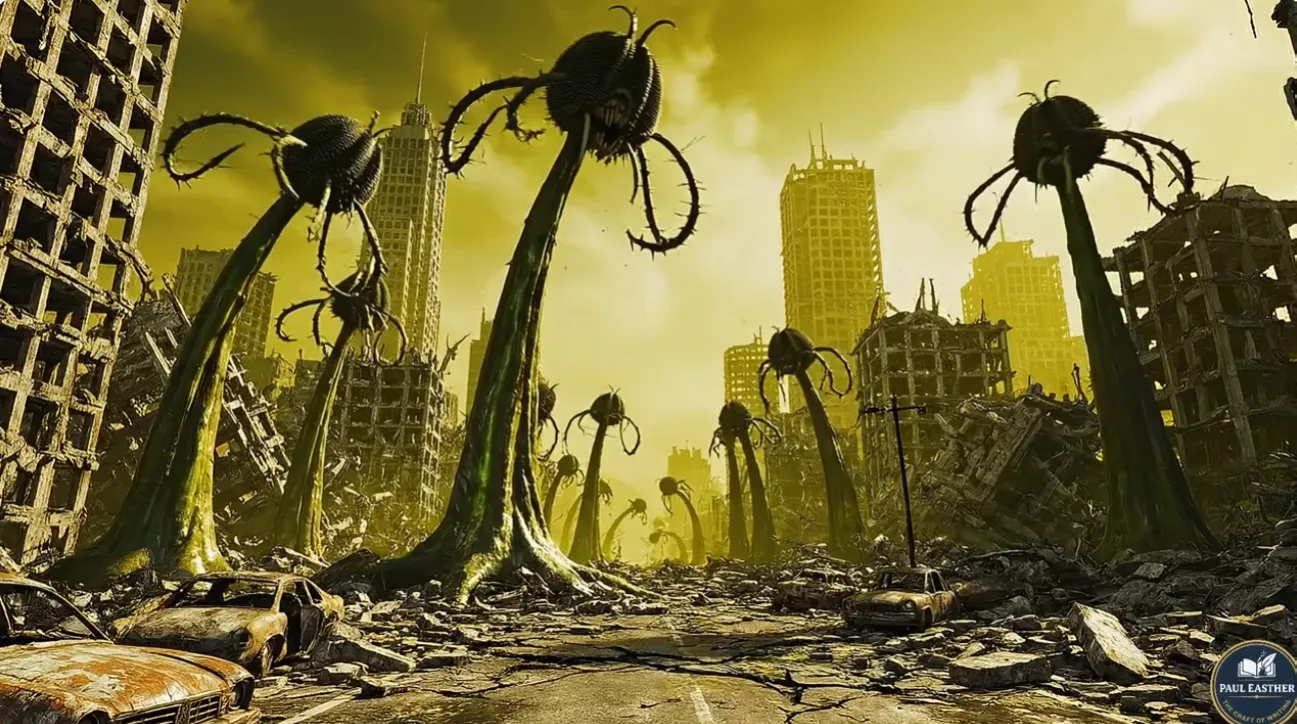
Once the sound seems intentional, every rattle becomes a question. If one triffid begins and another answers, the noises may form a network.
The plants no longer resemble separate predators accidentally occupying the same territory.
They begin to resemble an organised population.
A field of triffids might therefore be conducting a conversation while the humans nearby understand none of it.
The sound strips people of an important advantage. Humanity can speak, plan and coordinate—but perhaps it is no longer the only species capable of doing so.
Communication Without Understanding
Wyndham’s decision not to explain the rattling completely is essential.
If he provided a triffid dictionary, the mystery would disappear. The plants would become strange characters speaking a language that could eventually be decoded.
Instead, people can only observe patterns.
The rattling seems to pass between the plants. Its frequency changes. At times, the triffids appear more active after producing it.
These clues suggest communication without proving precisely what is being communicated.
That uncertainty places the reader in an uncomfortable position. We know enough to suspect intelligence but not enough to predict its plans.
It is like hearing muffled voices behind a wall. The words are indistinct, yet their urgency is unmistakable.
The inability to understand becomes part of the danger.
A Mechanical Sound from a Living Thing
The clatter also blurs the distinction between organism and machine.
The triffids are plants, but their sound is hard, percussive and mechanical. It resembles components striking together more than a living creature expressing emotion.
This makes their behaviour feel procedural.
A wolf may attack because it is hungry or frightened. A human enemy might hesitate, feel pity or change their mind.
A machine performs its function.
The triffids’ rattling suggests a process unfolding without anger, excitement or remorse. They do not need to hate humanity. They merely recognise people as vulnerable prey.
That emotional emptiness makes them more disturbing.
A creature driven by rage might eventually become exhausted.
A process simply continues.
From Garden to Battlefield
Before the disaster, the triffids are cultivated for their valuable oil. They exist in farms, laboratories and private gardens. People restrain them, remove their stings and treat them as dangerous but manageable agricultural products.
After most of humanity loses its sight, the relationship reverses.
The crop becomes the hunter.
The farmer becomes prey.
The same rattling that might once have been ignored now carries across abandoned roads, fields and settlements. Because many survivors cannot see, sound becomes essential to locating the approaching plants.
The clatter functions as both warning and threat.
People hear the danger coming—but hearing it does not necessarily mean they can escape.
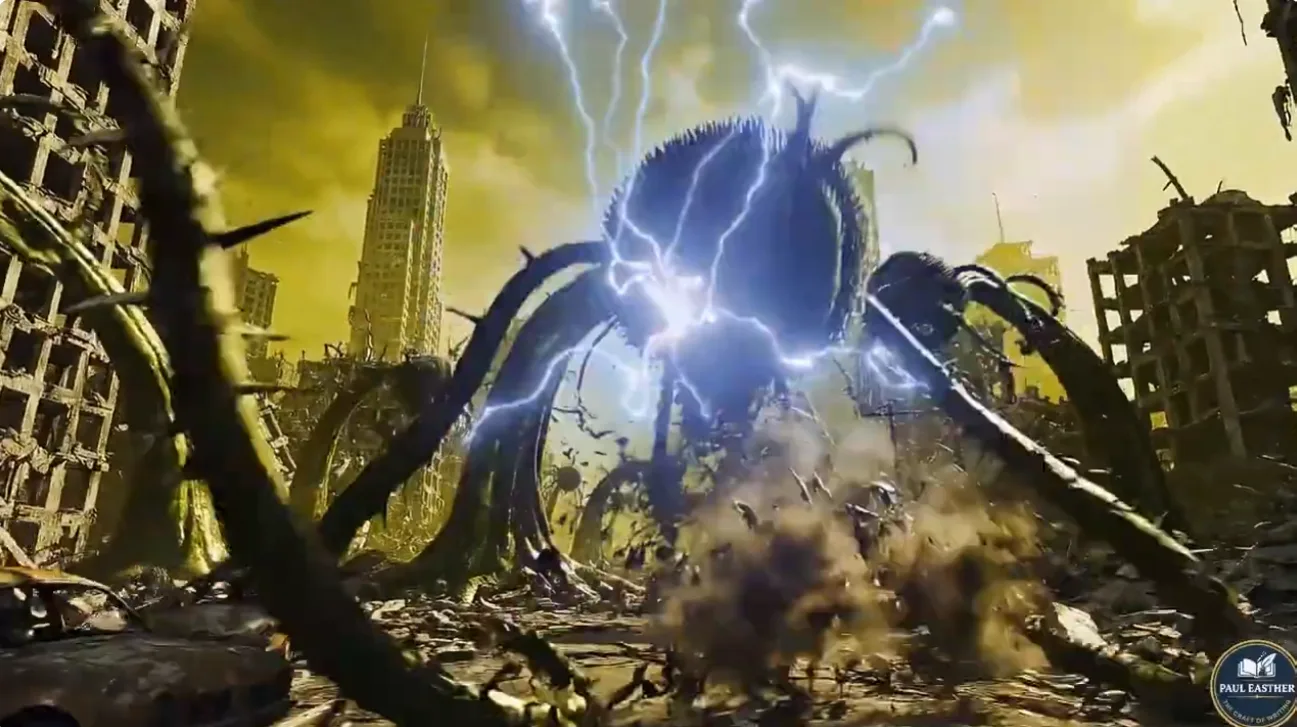
The garden has become a battlefield, yet there are no shouted orders. The enemy’s strategy, if it has one, passes through a code of taps and rattles.
Humanity is fighting a war while unable to intercept the other side’s communications.
The Feeling: The Inhuman Conversation
Wyndham’s technique creates what we might call the Inhuman Conversation: the disturbing sense that something around us is exchanging information in a language we cannot enter.
The effect differs from simply confronting an intelligent monster.
A speaking monster acknowledges the human world. It uses our words and therefore participates, however violently, in our system of meaning.
The triffids do not accommodate us.
Their rattling belongs entirely to them.
The humans can listen, speculate and attempt to identify patterns, but they remain outsiders. That exclusion diminishes humanity’s assumed position at the centre of the world.
Perhaps the triffids have always been communicating.
Perhaps people heard them but failed to listen.
And perhaps, now that civilisation has fallen silent, the plants finally have the louder voice.
Sound Reveals Collective Intelligence
A single triffid is dangerous because of its sting.
A population of communicating triffids is something more serious.
It can coordinate.
This is where Wyndham enlarges the threat without making the individual creature physically bigger. He connects them through sound.
One noise appears to pass to another plant, then another. The reader begins imagining information spreading across a whole field.
The enemy is no longer one object.
It is a system.
Writers can use this principle whenever they need to transform several small threats into one large presence. Repeated signals—a whistle, click, birdcall or electronic tone—can imply that apparently separate individuals belong to a coordinated whole.
The sound creates the connection.
What Writers Can Learn from Wyndham
When inventing a creature, do not consider only what it looks like.
Ask what it sounds like.
More importantly, ask whether its sound should reveal anything about the way it thinks.
Consider:
Does it communicate through breath, vibration, impact or movement? Does the sound resemble an animal, a person or a machine? Can humans understand it, or only recognise recurring patterns? Does one creature answer another? Does the sound change before an attack? Can it travel farther than the creature can see?
Avoid relying automatically on growls and roars. Those sounds carry familiar emotional meanings.
A genuinely unfamiliar species may make a noise that humans struggle even to classify.
That struggle can become part of the story.
Try It Yourself
Invent a creature that has no mouth.
Give it a method of producing sound: striking parts of its body together, vibrating the ground, flexing hollow bones or forcing air through openings in its skin.
Now place three of the creatures around a character.
One makes the sound.
A second answers from farther away.
Then a third responds from directly behind the character.
Do not translate the signal. Let the character infer its meaning from what the creatures do next.
The reader should understand that a conversation has taken place while remaining excluded from it.
John Wyndham shows us that monsters do not need to scream.
Sometimes the most disturbing sound is quieter: dry sticks striking hollow stems while a message passes from plant to plant.
And humanity has no idea what they are saying.
This is the fourth article in the Stop Writing in Silence series.