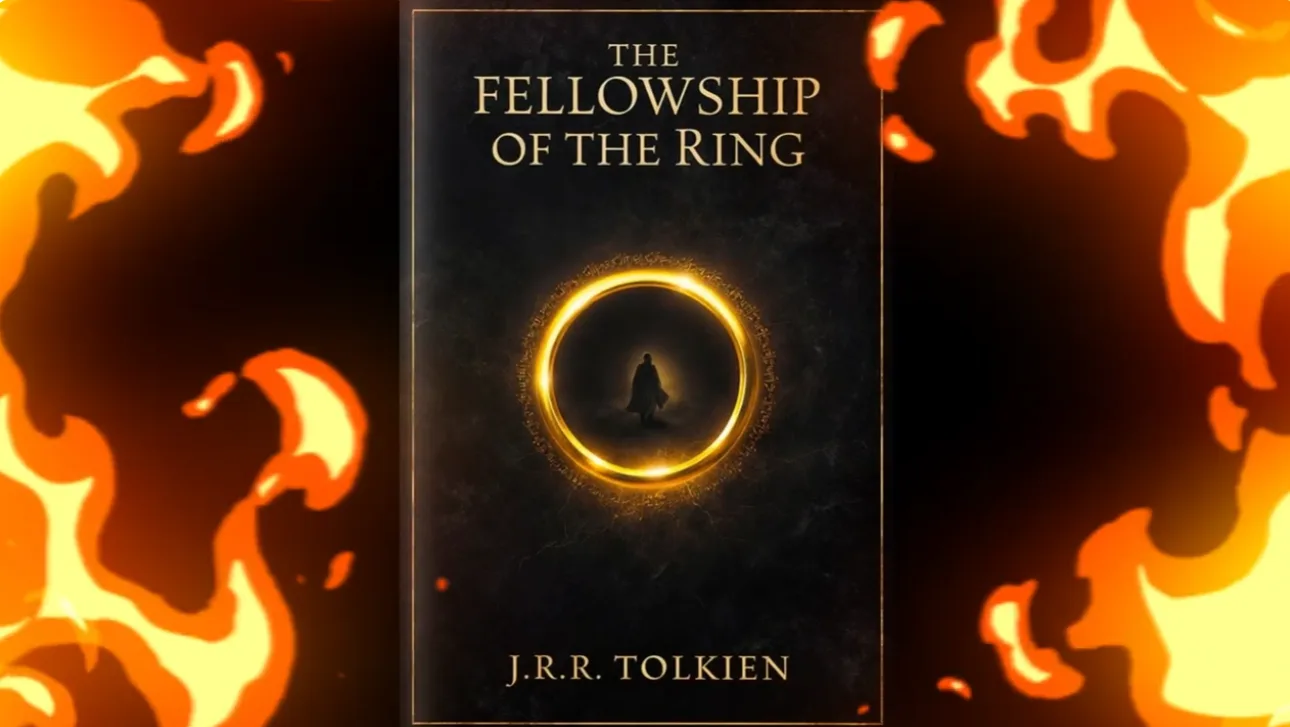
How Tolkien turns a single drumbeat into the sound of an enormous and inescapable fate.
The Power of Sound in Writing
You do not simply read a great book. You hear it.
Reading may appear silent, but the best books create an entire soundscape inside the imagination. A distant train, a ticking clock, a humming city or the snap of a pencil can establish place, pace and emotion before anything important happens.
Sound can warn us about something we cannot see.
Shirley Jackson uses violent knocking to give an unseen presence physical weight. Harper Lee uses footsteps to measure the shrinking distance between two children and their pursuer.
J.R.R. Tolkien goes further.
In the Mines of Moria, he turns sound into destiny.
The Fellowship hears a drum beating far beneath the earth. Its rhythm announces that something has awakened, something is approaching—and escape may already be impossible.
Tolkien and The Fellowship of the Ring
Published in 1954, The Fellowship of the Ring follows Frodo Baggins and his companions as they begin their attempt to destroy the One Ring.
Their journey takes them beneath the Misty Mountains and into Moria, a vast underground kingdom constructed by the Dwarves. Once it was a place of extraordinary skill, wealth and power. Now its halls are deserted, its passages are dark and its history has ended in violence.
The Fellowship reaches the Chamber of Mazarbul and discovers the tomb of Balin. There, Gandalf reads a damaged record describing the final days of the doomed Dwarven colony.
The surviving Dwarves were surrounded.
They could not escape.
The final entry ends with a warning:
Drums, drums in the deep.
Then, as though Moria has heard Gandalf reading its history aloud, the sound returns.
The First Beat
Tolkien begins with a tremendous rolling noise from somewhere far below. It is not merely heard through the air. It seems to tremble within the stone beneath the Fellowship’s feet.
Then it comes again:
“Doom, doom it rolled again…”
This is an astonishing word choice.
Tolkien could have written boom. That would have described the sound accurately enough: deep, forceful and percussive.
Instead, he writes doom.
Only one letter has changed, but the meaning has become enormous.
Boom describes what the characters hear.
Doom describes what they fear.
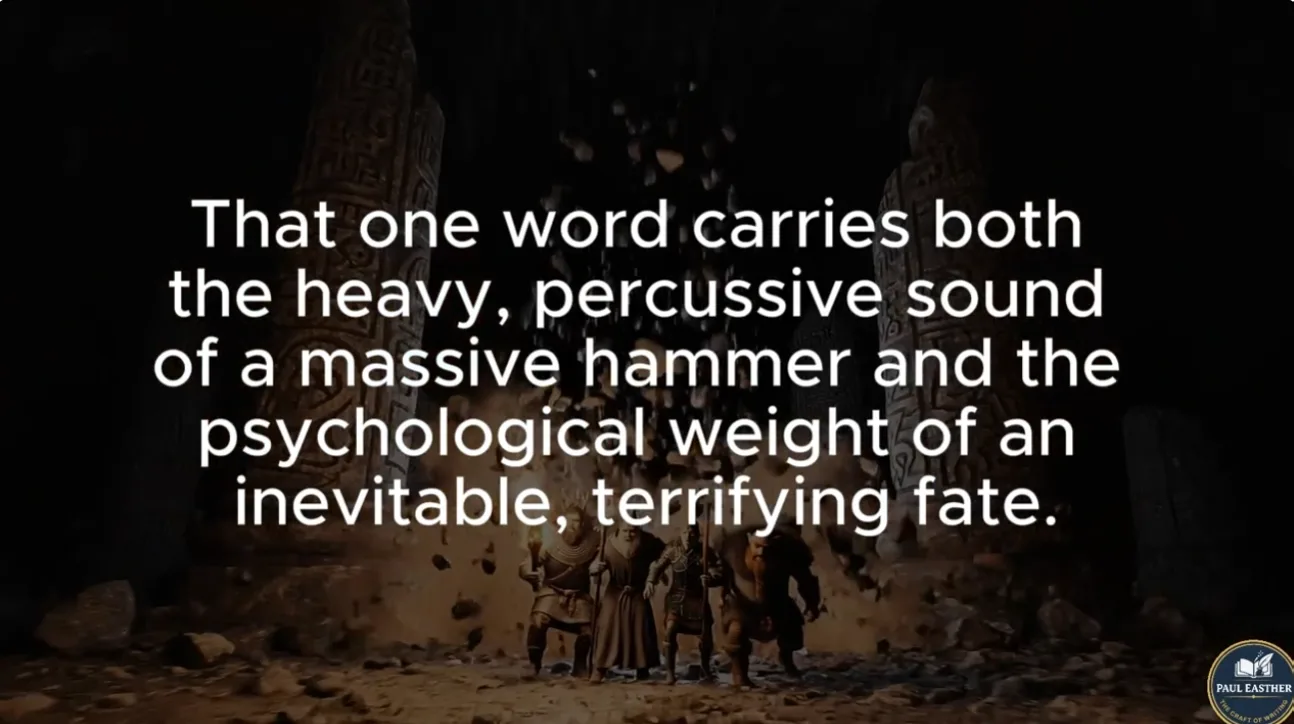
The sound therefore operates on two levels simultaneously. It is a noise moving through the caverns and a warning moving through the characters’ minds.
The drumbeat does not simply announce an enemy.
It announces an ending.
The Trick: Make Sound Mean More Than Sound
Onomatopoeia uses words that imitate noises: hiss, buzz, crack, clang.
Tolkien’s doom does something more sophisticated. It resembles the heavy resonance of the drum while also carrying an independent meaning.
The Fellowship has just read the final words of people who were trapped in exactly the same chamber. Now they hear the same drums.
The past and present suddenly overlap.
The Dwarves heard the drums before they died.
The Fellowship hears them now.
That association means every beat carries the memory of the earlier disaster. The sound predicts that history may repeat itself.
This is why doom feels inevitable. The word does not suggest that danger might arrive. It sounds like a verdict that has already been delivered.
Rhythm Creates the Pursuit
The drum does not beat continuously.
It strikes.
It pauses.
Then it strikes again.
That broken rhythm creates anticipation because the reader begins waiting for the next beat. Each silence becomes a space in which the characters—and we—imagine what is coming.
Doom, doom.
Pause.
Doom, doom.
The repetition resembles marching feet, a heartbeat or the tolling of an enormous bell. It gives the approaching danger a steady purpose.
Chaos might be survivable.
A disciplined rhythm suggests something organised and relentless.
As the attack begins, Tolkien adds other sounds: horns, cries, running feet, clattering weapons and voices issuing desperate commands. The soundscape expands from one distant drum into the noise of imminent battle.
Yet the drum remains underneath everything.
It is the pulse of the scene.
From Hearing to Feeling
Tolkien anchors the sound in the physical world by making the stone tremble and the walls shake.
This changes the scale of the threat.
A sound travelling through air might come from a creature somewhere in the tunnels. A vibration passing through the floor makes the entire mountain appear to participate.
The characters are not merely standing near the noise.
They are standing inside the instrument producing it.
Moria becomes a vast drum, its caverns carrying and magnifying every impact. The mountain no longer feels like shelter. It becomes an enclosed body transmitting warning signals through its bones.
This is the difference between describing volume and describing force.
Saying that a sound is very loud provides information.
Showing dust falling, water trembling or stone vibrating gives the sound physical consequences. The reader can imagine what it would feel like in the chest, feet and bones.
The body hears before the mind fully understands.
The Feeling: The March of Doom
Tolkien’s technique creates what we might call the March of Doom: the sensation that an unseen but overwhelming force is approaching with mechanical certainty.
The Fellowship cannot yet see what is coming. However, every drumbeat tells them three things:
It is powerful.
It is getting closer.
It knows where they are.
Unlike Harper Lee’s footsteps, the sound does not belong to one hidden human pursuer. It seems to represent the whole subterranean world turning against the travellers.
The effect is larger than fear of attack. It is the feeling that the escape route is closing and that the mountain itself has pronounced judgement upon them.
The Fellowship can run.
The drumbeat tells us that running may not matter.
The Strength of a Simple Word
Fantasy writers sometimes believe that scale requires elaborate description. A gigantic threat must be accompanied by gigantic sentences, extensive history and multiple paragraphs explaining its power.
Tolkien demonstrates the opposite.
Doom.
One syllable.
One heavy beat.
Its simplicity gives it authority. There is no qualification or uncertainty in the word. It lands with the blunt force of a hammer.
Repetition strengthens it. Tolkien does not have to invent a more elaborate sound with every appearance. The same word returns, and its meaning grows because the situation has worsened.
A repeated sound can become a story’s warning signal.
Once established, it carries everything the reader has learned to associate with it. Each recurrence arrives already loaded with memory.
What Writers Can Learn from Tolkien
A powerful sound should do more than identify a noise.
Consider whether it can also communicate:
Scale: Does it shake or alter the environment? Distance: Is it faint, approaching or surrounding the characters? Rhythm: Is it random, repeated or relentlessly regular? Meaning: Does the sound resemble a word or awaken an association? * Prediction: Has the reader learned what normally follows it?
You can also make a setting amplify the sound.
A footstep in an open field disappears quickly. The same footstep in a tunnel repeats through echoes. A knock inside an ordinary room comes from one direction. A vibration travelling through a mountain seems to come from everywhere.
Do not simply ask what creates the sound.
Ask what carries it.
Try It Yourself
Place a character inside an enclosed setting: a tunnel, ship, cellar, lift or abandoned factory.
Introduce one distant, repeated sound.
Choose a word that suggests both the noise and its emotional meaning. Perhaps it is a tick that measures disappearing time, a groan that makes a building appear alive or a hush that seems to command silence.
Repeat it once.
Pause.
Then show its physical effect. Let dust drift from a beam. Let a glass ripple. Let the character feel the floor respond beneath their feet.
Do not reveal the source immediately.
Allow the reader to imagine something large enough to make the entire setting react.
Tolkien understood that the most terrifying sound is not necessarily a scream, an explosion or the roar of a monster.
Sometimes it is only a drum in the darkness.
Doom, doom.
And then the walls begin to shake.
This is the third article in the Stop Writing in Silence series.