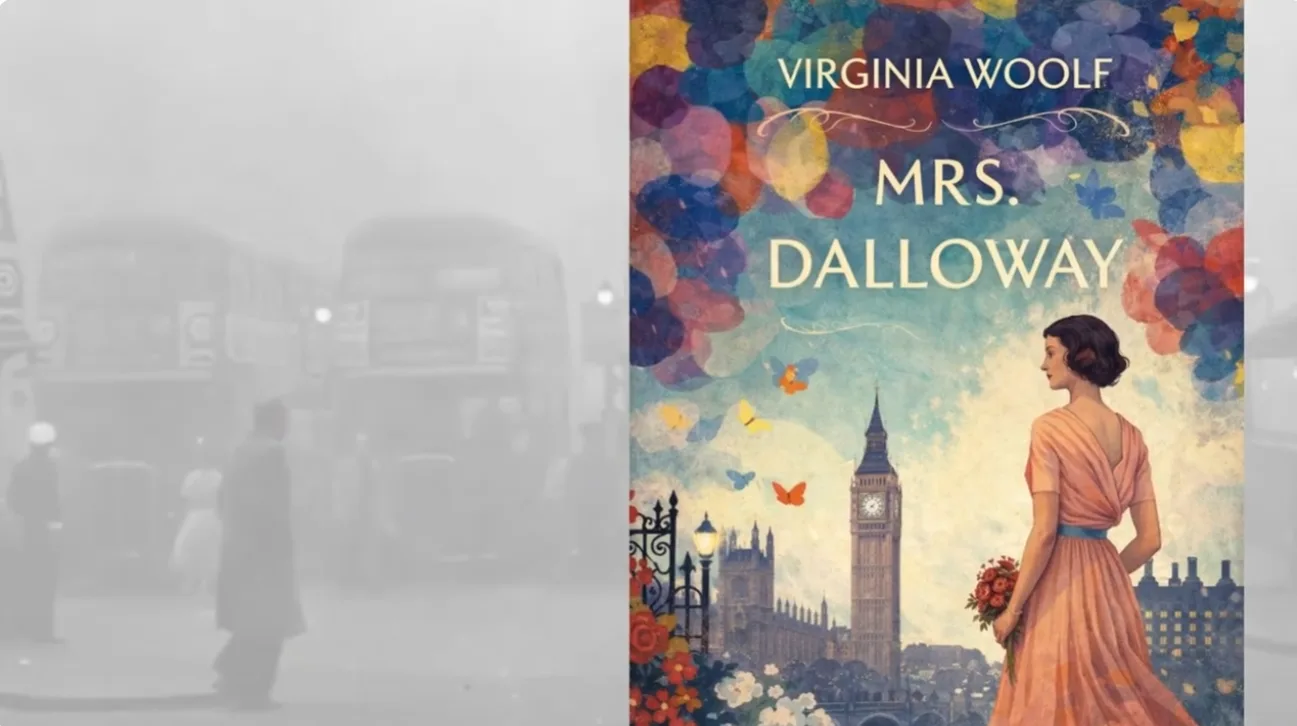
Every strike of Big Ben divides life into what can still happen and what never can again.
The Sound That Holds the Day Together
You do not simply read a great book. You hear it.
Throughout this Stop Writing in Silence series, we have heard houses bang, footsteps approach, mountains tremble, plants clatter, weapons click, courtiers whisper, marlins strike the sea, fairs announce miracles and telescreens invade private rooms.
Virginia Woolf gives sound another power.
In Mrs Dalloway, sound connects people who may never meet. The citizens of London follow separate streets, carry private memories and experience the same day in radically different ways. Yet the bells of Big Ben reach all of them.
The clock does more than tell the time.
It interrupts thought.
It summons memory.
It measures mortality.
And it holds a fragmented city inside one shared moment.
One Day, Many Inner Worlds
Published in 1925, Mrs Dalloway unfolds over the course of a single June day.
Clarissa Dalloway walks through London buying flowers and preparing for a party that evening. Around her, the city moves with carriages, motorcars, omnibuses, pedestrians, aircraft, music and conversation.
But the novel also travels inward.
A sight, smell or sound can transport Clarissa from the London street into a memory of her youth at Bourton. Another sound can move the narrative into the mind of somebody nearby. Past and present exist together because consciousness does not experience time as a tidy sequence.
The mind wanders.
The clock does not.
Again and again, Big Ben calls the characters back to the measurable world.
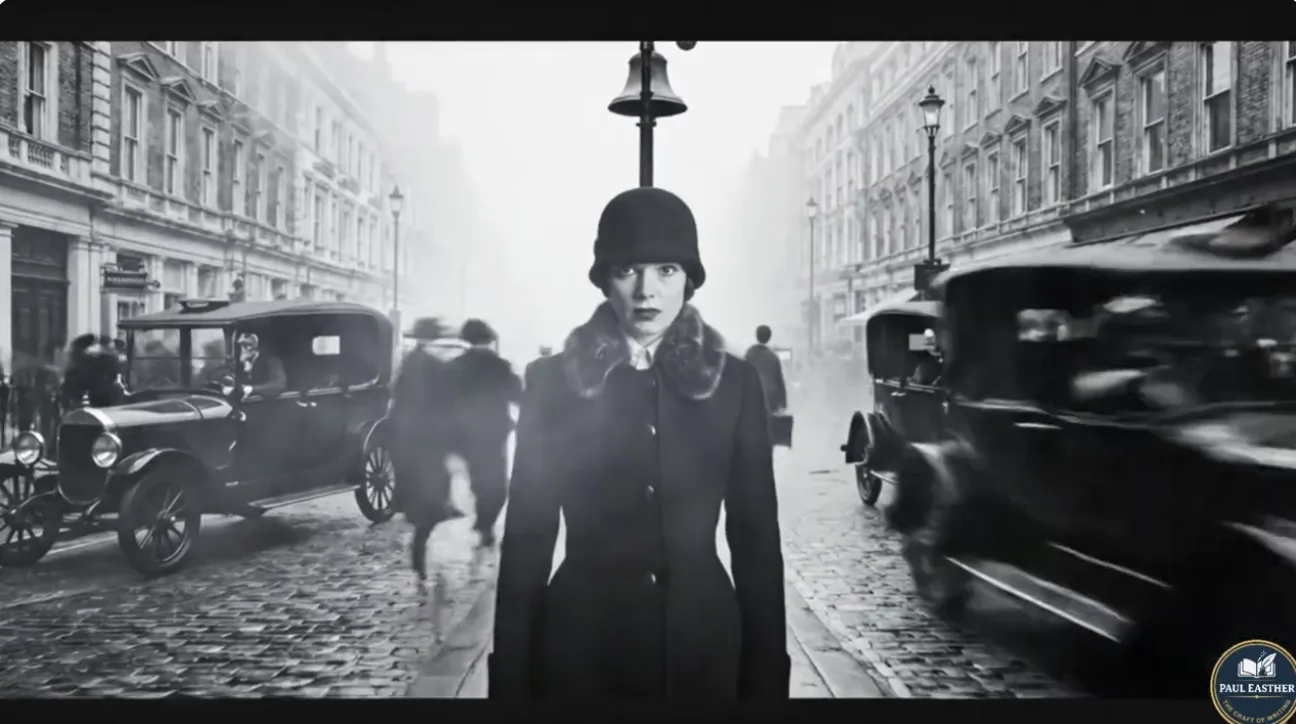
The Correct Order of the Chimes
The quotation in the original video contains Woolf’s words, but reverses their sequence.
The passage appears in the novel as:
“There! Out it boomed. First a warning, musical; then the hour, irrevocable. The leaden circles dissolved in the air.”
That order matters.
First comes anticipation.
Clarissa senses a hush even amid London traffic. There is a pause before the bell strikes—a moment of suspense in which the future remains open.
Then comes the warning.
Then the hour.
Only afterwards do the “leaden circles” spread through the air and disappear.
Woolf turns an invisible vibration into something with weight, shape and movement. We can almost see each ring widening over the rooftops, passing through windows and touching everyone within reach.
The sound dissolves.
The hour it announces does not return.
A Warning, Musical
Woolf calls the first sound a “warning,” but immediately follows it with “musical.”
Those words pull in different emotional directions.
A warning suggests danger. It prepares us for something unwanted or unavoidable.
Musical suggests pattern, beauty and pleasure.
Big Ben contains both.
Its chimes are beautiful because they give form to time. They organise the chaos of the city into hours and intervals. But every beautiful chime also announces that another portion of life has passed.
That is why the next word is so powerful:
Irrevocable.
An hour cannot be recalled, corrected or lived again. Once the bell names it, it belongs to the past.
The chime is therefore not merely information. It is a verdict.
Giving Sound a Body
Sound cannot normally be seen or held.
Woolf gives it a physical form.
The circles are leaden—heavy, grey and burdened with consequence. Lead is not light or decorative. It falls. It weighs things down. It suggests solemnity and even death.
Yet these heavy circles also dissolve.
That contradiction captures the strange nature of time. A moment can feel unbearably important while it is happening, then vanish almost immediately. Its physical presence disappears, but its emotional effect remains.
Woolf could simply have written that Big Ben rang.
Instead, she makes its sound travel through space and consciousness.
The description changes a clock into a force passing across London.
The City as an Orchestra
Big Ben may provide the dominant beat, but it is not the novel’s only sound.
Clarissa loves London partly through its noise:
The swing, tramp and trudge of people.
The bellow and uproar of traffic.
The sounds of carriages, motorcars and omnibuses.
Brass bands and barrel organs.
The jingle and the strange high singing of an aeroplane.
This list has its own rhythm. Woolf does not describe the city from a safe distance. She places Clarissa inside its movement and lets one sound run into another.
London becomes an orchestra without a conductor.
Some sounds are mechanical. Some are musical. Some come from bodies pushing through crowds. Together they produce the restless energy Clarissa recognises as life itself.
She does not love London despite its noise.
She loves it through its noise.
Public Sound, Private Meaning
Big Ben rings for everybody, but it does not mean the same thing to everybody.
For Clarissa, the clock can awaken memories of youth, choices, relationships and the approach of old age.
For another person, the same bell may announce an appointment, a missed opportunity or another hour survived.
For Septimus Warren Smith, a traumatised veteran of the First World War, the external world behaves differently. Sounds and sights can become messages charged with terrifying personal significance. His mind cannot keep the public world separate from the private meanings it generates.
Woolf therefore gives us a city sharing one physical sound but experiencing countless emotional versions of it.
This is one of her great achievements.
She uses sound as a bridge between consciousnesses without pretending that those consciousnesses are identical.
Everybody hears the bell.
Nobody hears precisely the same bell.
Sound as a Narrative Hinge
Woolf moves between characters with extraordinary fluidity.
A conventional novel might separate viewpoints with a new chapter or a clearly marked scene break. Woolf often uses a shared event instead.
A motorcar backfires.
An aeroplane passes overhead.
A clock strikes.
Several people hear the same sound, and the narrative slips from one mind into another.
Sound becomes a hinge.
On one side is one person’s private thought. On the other is the thought of a stranger standing somewhere nearby. The noise belongs to neither of them, which means it can connect them without requiring an introduction.
This technique makes London feel both crowded and lonely.
Thousands of people occupy the same city. Their lives continually brush against one another through noises, glances and movements, yet much of what they feel remains hidden.
Silence Before the Strike
The pause before Big Ben is as important as the bell itself.
Clarissa senses “a particular hush” and “an indescribable pause” even amid the traffic. Woolf creates suspense not by silencing London completely, but by focusing Clarissa’s attention so intensely that the rest of the city appears to hold its breath.
This is a powerful lesson for writers.
A loud sound becomes more effective when it is preceded by restraint.
The reader needs the intake of breath before the shout, the held silence before the gunshot and the expectant pause before the clock strikes.
Without contrast, volume becomes ordinary.
Woolf lets us anticipate Big Ben before we hear it. The sound occupies Clarissa’s mind while it is still approaching.
The Clock and Mortality
Mrs Dalloway is filled with life: flowers, parties, traffic, friendship, fashion, memory and desire.
It is also filled with death.
Clarissa has recently recovered from illness. She is conscious of age and of the lives she might have led. Septimus lives with psychological injuries that other people cannot comprehend.
Big Ben speaks to both sides of the novel.
Its music belongs to the living city.
Its irrevocable hour reminds everyone that life is finite.
Near the novel’s conclusion, Clarissa learns that a young man she has never met has died. His death enters her party as information, but she experiences it privately and intensely. Once again, the clock is striking and the leaden circles dissolve.
The sound connects a crowded celebration to a solitary death.
Time includes them both.

What Writers Can Learn from Woolf
A recurring sound can give structure to a story without feeling like a mechanical device.
Choose a sound that naturally belongs to your setting:
A school bell.
A distant train.
A factory siren.
A neighbour’s gate.
A church clock.
Aircraft passing overhead.
Let the sound return at meaningful intervals. Each time, allow a different character to hear it—or let the same character hear it differently because something has changed.
The first bell may promise freedom.
The second may announce lateness.
The third may remind someone of a person who is gone.
The sound remains physically consistent while its emotional meaning develops.
That is how repetition becomes depth.
Try It Yourself
Write a scene involving three people in different parts of the same location.
They might occupy separate rooms in a hospital, different streets in a town or distant houses near a railway line.
Give them one shared sound.
When it occurs, move briefly into each person’s thoughts. Do not explain the connection between them. Let their reactions reveal it.
One person welcomes the sound.
One fears it.
One barely notices it until a memory surfaces.
Then repeat the sound near the end of the scene after something important has happened.
Ask yourself: does it now mean something different?
If it does, the sound has become part of the story rather than decoration around it.
When the## When the Hour Becomes Irrevocable
Virginia Woolf turns Big Ben into far more than a London landmark.
Its bells organise the novel’s single day while repeatedly breaking into the private flow of thought. They connect strangers, awaken the past and remind the living that time continues regardless of memory, regret or desire.
The circles dissolve because sound must disappear.
The hour remains irrevocable because time does not return.
That combination gives Woolf’s description its extraordinary emotional weight. Big Ben is musical, beautiful and communal—but every chime also carries each character a little further towards the end of the day.
And towards the end of life.
This is the tenth article in the Stop Writing in Silence series.