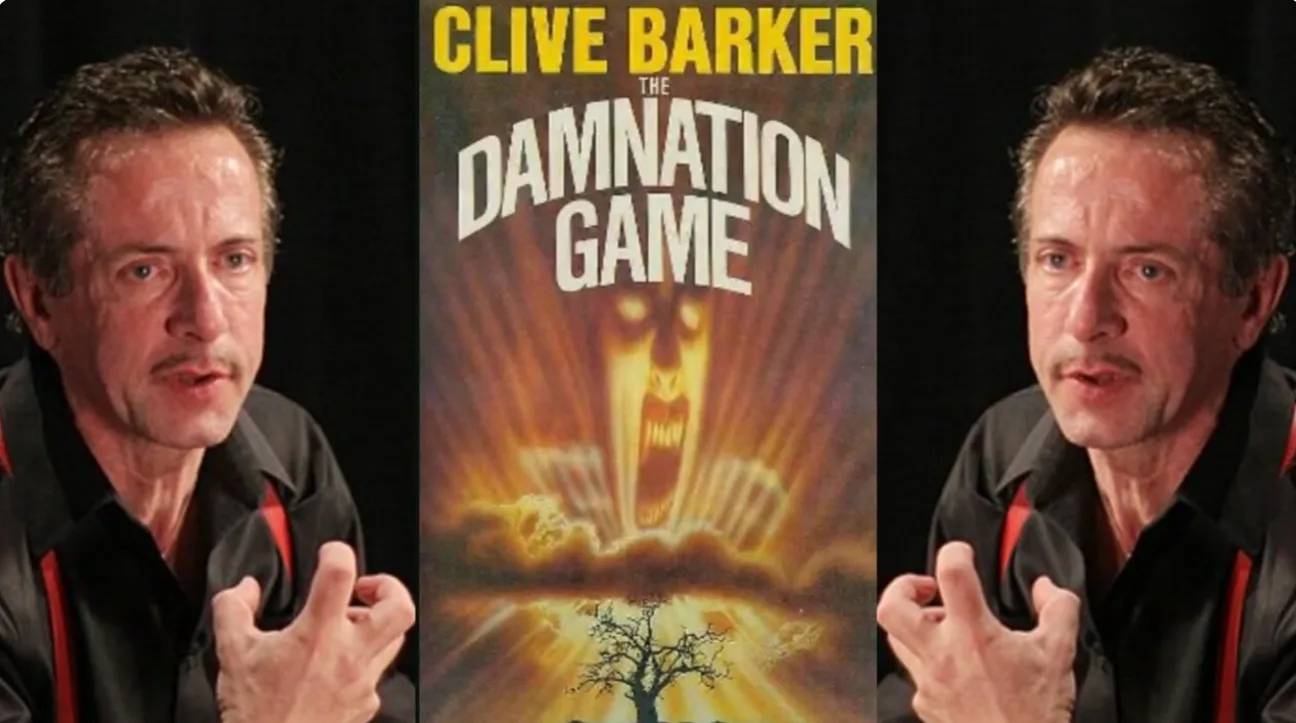
# Clive Barker and Smell as Forensic Proof
Most writers wait for a character to find the clue.
Clive Barker lets them smell it.
In Barker’s horror, odour is rarely harmless atmosphere. Blood, sweat, rot and unnatural sweetness announce that something has happened—or that something impossible has entered the room.
The character may not yet see the corpse. They may not understand what is moving in the darkness. The walls may appear intact and the floorboards undisturbed.
But the air has already given evidence.
This is smell as forensic proof.
A detective normally collects fingerprints, fibres and bloodstains. Barker’s characters often receive an earlier warning: the physical world smells wrong. The odour proves that the horror possesses matter, history and consequence.
The monster isn’t merely an idea.
It has left something in the air.
When the Body Becomes Evidence
In The Damnation Game, Barker repeatedly confronts readers with the instability of the human body.
Bodies sweat, bleed, decay and return in forms that should not be possible. The supernatural does not remain ghostly or clean. It enters flesh.
That makes smell particularly important.
A visual apparition might be dismissed as a hallucination. A noise could come from another room. But bodily decay has chemical force. It occupies the air and enters everyone who breathes it.
A corpse’s smell proves that time is acting upon it.
If that corpse is still moving, the smell proves something even worse: death and movement are occupying the same body.
Barker uses this contradiction to make supernatural horror feel physical. The reader is not observing a transparent ghost floating safely above the floor. They are sharing space with something wet, decomposing and materially present.
Fear Leaves a Human Trace
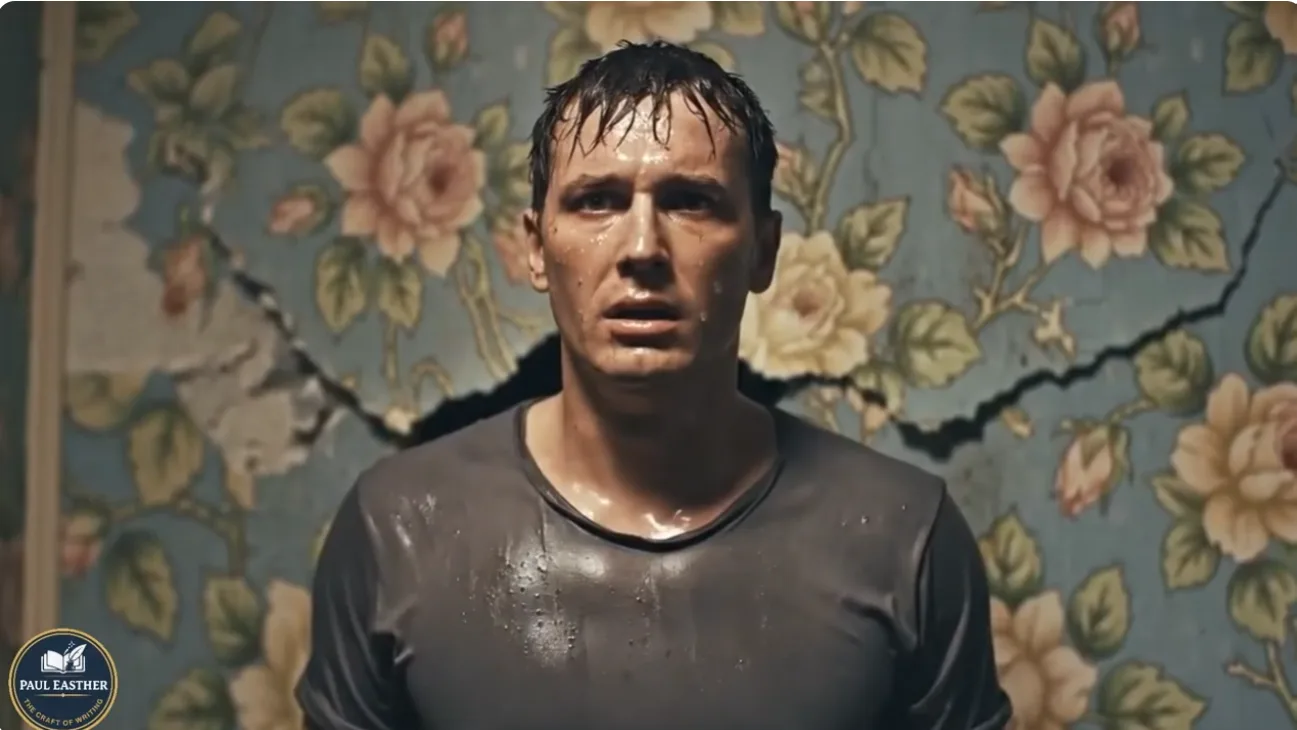
Stale sweat is one of horror’s most useful smells because it reveals an invisible event.
A frightened person may have left the room hours earlier, but their fear can remain in clothing, bedding or enclosed air.
The writer does not need to show the panic itself.
Imagine a character entering an apparently empty room. The bed is made. The window is closed. Nothing seems broken.
Then the character smells stale sweat.
Suddenly, the room contains a previous human body. Someone waited there. Someone was frightened. Something made them perspire heavily enough for the odour to remain.
The smell is evidence of an experience.
This is an important distinction. Fresh sweat belongs to present exertion. Stale sweat suggests that the event has already happened and its witness may be gone.
Smell gives the room a history.
The Copper Warning
Writers often describe blood as metallic or coppery.
The comparison works because it gives blood a recognisable sensory identity without requiring the character to see it. A metallic tang can announce injury, violence or death from beyond a doorway.
That delay creates suspense.
The character recognises the category of danger but not its scale.
Is it a cut finger?
An injured animal?
A murder?
The smell provides proof while withholding the complete picture.
Barker thrives in that interval between recognition and revelation. The body understands that something is wrong before the mind knows precisely what it has encountered.
The character can proceed toward the source or attempt to escape it, but the reader is already imagining what waits ahead.
In horror, the imagination usually produces something worse than an immediate explanation.
Put the Evidence Behind the Wall
Consider this sentence:
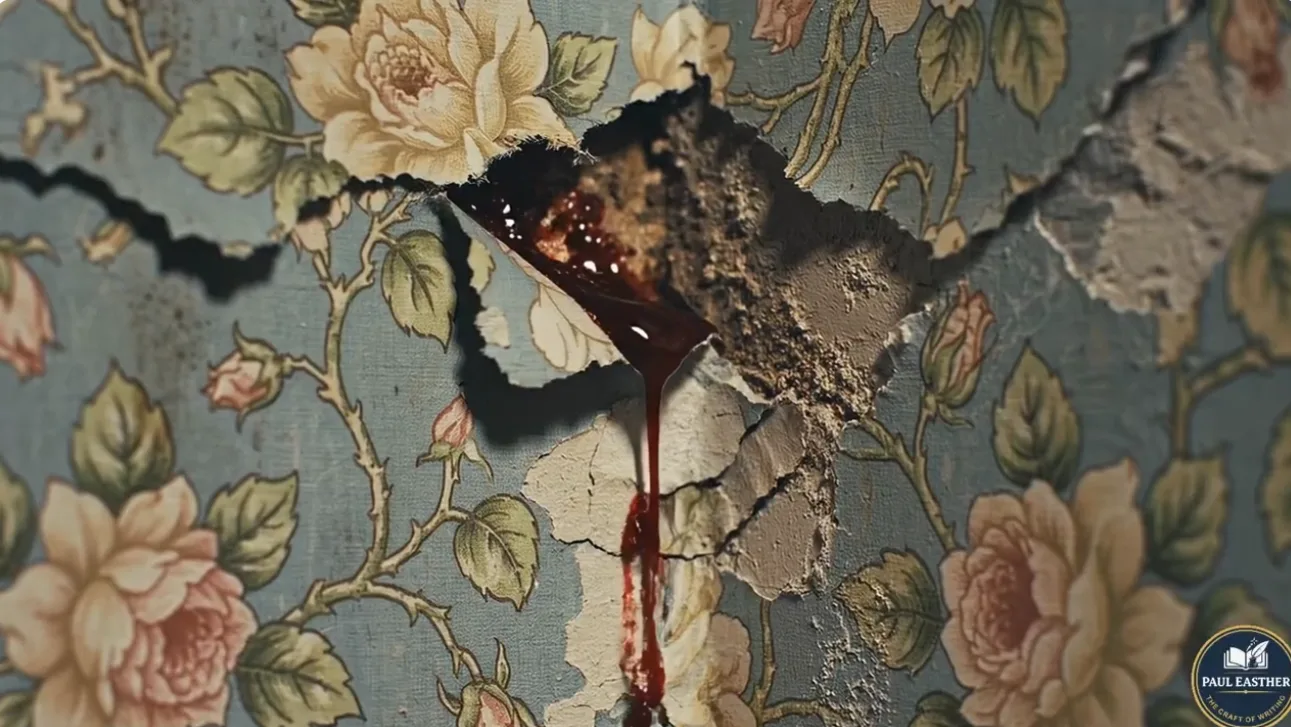
The room smelled of stale sweat and the dry, coppery scent of old blood behind the wallpaper.
This is not a quotation from Barker. It is a useful demonstration of his forensic principle.
The sentence contains three pieces of evidence.
Stale sweat suggests that a frightened human being occupied the room.
Old blood suggests injury or violence.
Behind the wallpaper suggests concealment and elapsed time.
The horror is no longer a sudden event. It has become a secret the house has been keeping.
Placing the smell behind a surface also creates conflict between sight and scent. The wallpaper says the wall is complete. The smell says it is not.
One sense is lying.
The character must decide whether to trust the pleasant floral pattern or the evidence entering their lungs.
Barker’s horror repeatedly operates through this collapse of surfaces. Skin can hide corruption. Respectability can conceal appetite. A beautiful exterior can cover decay—but never perfectly.
Something leaks through.
The House as Witness
When a hidden event leaves an odour, the setting stops being passive.
The room becomes a witness.
It cannot speak, but it can release evidence through gaps in plaster, beneath doors or between floorboards. Heat may strengthen the smell. Rain may release it from timber. A closed window may preserve it.
This gives the writer a powerful way to make a building participate in the story.
A house can conceal what happened while simultaneously betraying it.
The characters who live there may paint the walls, replace the carpet or burn incense. Yet the original event continues to press outward.
The smell says:
Something happened here.
Someone tried to hide it.
The hiding failed.
That is far more unsettling than a generic “creepy old house.” The building possesses a specific history whose physical residue remains active.
Sweetness Can Also Be Evidence
Barker does not rely only on conventionally disgusting smells.
In his fiction, sweetness can be equally disturbing when it accompanies mutilation, death or supernatural corruption. An unexpectedly pleasant scent creates a sensory contradiction.
The eyes see injury.
The nose receives perfume.
The disagreement makes the scene feel unnatural because the senses no longer support the same reality.
Sweetness may indicate camouflage. It may suggest that something is attempting to imitate beauty or cover decay. It may simply make the grotesque harder to categorise.
This connects Barker to Gillian Flynn’s perfumed rot, but the effect is different.
Flynn’s pleasant smells often conceal psychological and domestic corruption.
Barker pushes further into the body. Sweetness and putrefaction mingle until attraction and revulsion become difficult to separate.
The reader wants to retreat but is compelled to examine the source.
Make the Clue Arrive First
If you are writing horror, crime or suspense, try reversing the usual order of discovery.
Instead of:
- The character finds a body.
- The character notices the smell.
Use:
- The character notices an odour.
- The character searches for its source.
- The explanation becomes progressively worse.
That delay gives the smell narrative work to do.
Immediate version:
She opened the cupboard and found a blood-soaked shirt.
Forensic version:
A metallic smell gathered near the cupboard. It strengthened when she placed her hand against the door.
The second version creates anticipation. The character and reader know that evidence exists, but they must choose to uncover it.
Smell becomes an invitation they do not want to accept.
Try It Yourself: Build a Scent Trail
Choose a hidden event:
A violent struggle An injured person A concealed animal A chemical experiment A body behind a wall Someone living secretly in the house * A room hurriedly cleaned before visitors arrive
Now identify three stages of smell.
Stage one: The uncertain trace
Give the character something faint and difficult to classify.
There was a sourness beneath the furniture polish.
Stage two: The recognised category
Allow the odour to become clearer.
Near the stairs, the sourness acquired a copper edge.
Stage three: The physical source
Finally reveal the evidence.
The smell was strongest beside the newly plastered wall.
Notice that the discovery develops without showing anything supernatural. The odour creates the investigation.
The reader begins searching the room alongside the character.
Let the Air Testify
Smell is useful because it cannot be reasoned away as easily as an uneasy feeling.
Instead of telling us that a character senses evil, Barker gives evil physical emissions. It bleeds, sweats, burns, sweetens and decomposes.
That materiality makes his horror difficult to escape.
Patrick Süskind constructs a cathedral from scent. Roald Dahl turns it into a visceral joke. Gillian Flynn makes fragrance lie. Raymond Chandler makes the air guilty. Leigh Bardugo makes an economy breathable. Toni Morrison allows memory to enter through the senses.
Clive Barker turns smell into testimony.
The wallpaper can hide the wound.
The air cannot.
This is the seventh article in The Scent of a Story series.