
If your reader cannot smell the smoke, your scene may not yet be alive.
The Forgotten Sense
A woman enters an old house.
The sentence is clear. We understand what happened, but we feel nothing.
So the writer adds description:
She entered the dark, dusty house.
Now we know slightly more about the building. It is old, dark and neglected. But it still exists at a distance. We are looking at it rather than entering it.
Then the writer tries something different:
She entered the house. The smell of cold, wet wool hit her—the scent of her father’s coat after the funeral.
Now something has happened.
Not to the house.
To the character—and possibly to the reader.
The smell has opened a door into memory. The building is no longer merely dark or dusty. It has become connected with a person, an absence and an unfinished emotion.
That is the particular power of smell in writing.
Sight tells us what a place looks like.
Sound tells us what is happening within it.
But smell can tell us where we are in our lives.
Why Smell Reaches So Deeply
Odours can produce unusually vivid and emotional autobiographical memories.
Our olfactory system has close neural connections with areas involved in emotion and memory, including the amygdala and hippocampus. That does not mean smell magically avoids all thought. It means scent can become entangled with emotional experience in a particularly immediate way.
The smell of chlorine may return someone to childhood swimming lessons.
Diesel fumes may recall a father’s workshop.
A particular soap may bring back a grandmother who has been dead for thirty years.
Smoke may mean a winter fireplace to one person and approaching disaster to another.
The odour contains no universal memory. The meaning comes from the life of the person smelling it.
That is why a well-chosen smell does more than furnish a room. It reveals character.
When to Use Smell
Smell is powerful partly because writers use it less frequently than sight.
If every paragraph contains another fragrance, aroma or stench, the effect becomes artificial. The reader begins to notice the author working.
Smell earns its place at moments of change.
Use it when a character enters a new environment.
Use it when danger becomes physically close.
Use it when an emotion changes.
Use it when the past unexpectedly enters the present.
Use it when one character notices something everybody else has missed.
In the wrong moment, smell is decorative filler.
In the right moment, it can reorganise the entire scene.
No modern novelist demonstrates this more forcefully than Patrick Süskind.
Patrick Süskind’s Cathedral of Scent
First published in German in 1985 and translated into English by John E. Woods in 1986, Perfume: The Story of a Murderer is built around smell at every level.
Its protagonist, Jean-Baptiste Grenouille, is born in eighteenth-century Paris with an extraordinary sense of smell—and no discernible personal scent of his own.
He experiences the world through odour with a precision other people reserve for sight and language. He can distinguish countless smells, separate their components and remember them long after their sources have disappeared.
This gift does not make him compassionate.
It makes him powerful.
Grenouille learns to treat the world as an enormous collection of scents that can be identified, captured, combined and manipulated. Eventually, his obsession with preserving human scent turns him into a murderer.
Süskind does not use smell as an occasional flourish.
He constructs an entire system of perception from it.
Paris Through the Nose
Historical fiction often introduces a city visually.
We see buildings, clothing, carriages, streets and famous landmarks. The details assure us that the author has completed the necessary research.
Süskind approaches Paris from another direction.
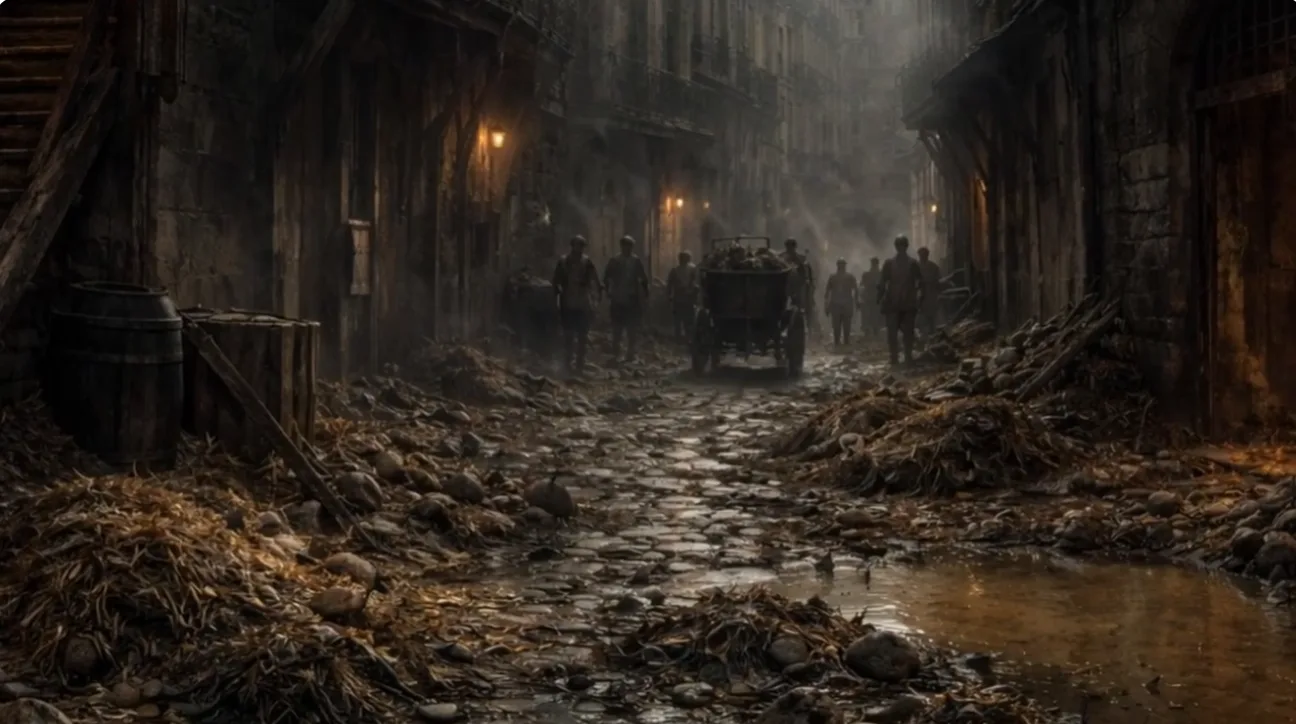
His city stinks.
Its streets contain animal waste, spoiled food, human sweat, dirty water and decaying matter. Houses retain the odours of cooking, sickness and bodies living too closely together.
The result is not a decorative period setting.
It is a physical environment the reader must endure.
Süskind’s Paris feels crowded because its smells overlap. One odour does not politely disappear before the next arrives. They mix, decay and fight for dominance.
The city seems to enter the body with every breath.
That is what makes the writing claustrophobic. The reader cannot simply look away from the unpleasant details. To remain inside the scene is to keep inhaling it.
Building Through Accumulation
Süskind builds what might be called a cathedral of scent.
A cathedral is not created from one stone. Its effect comes from scale, repetition, structure and accumulated detail.
Süskind works similarly.
He layers organic and manufactured smells: rotting produce, blood, leather, smoke, perfume, sewage, oils, herbs, wood and human skin.
Each smell contributes another material to the world.
The technique works because the odours are rarely vague. Something does not merely smell unpleasant. Its smell has a source, texture, age and stage of decay.
A melon splitting open in the heat produces a different sensation from old blood drying on a butcher’s block. Both may be disgusting, but they are not interchangeable.
Specificity makes the imagined smell possible.
The reader’s brain searches its own memory for something comparable and supplies the missing sensation.
Do Not Say “It Smelled Bad”
“Bad” is a judgement, not an experience.
If a writer tells us that a room smelled bad, we understand the character’s opinion but cannot recreate the odour.
The solution is not necessarily a longer list of adjectives. It is a more precise source.
A sour milk smell beneath the sweetness of air freshener.
Wet dog trapped in upholstery.
Cooking oil that has been reheated too many times.
Apples beginning to ferment inside a closed cupboard.
Each example gives the imagination something tangible to work with.
Süskind understands that smells become powerful when they suggest material processes. Something is rotting, burning, sweating, fermenting, bleeding or blooming.
The smell tells us what the world is doing even when no action is visible.
The Butcher’s Block
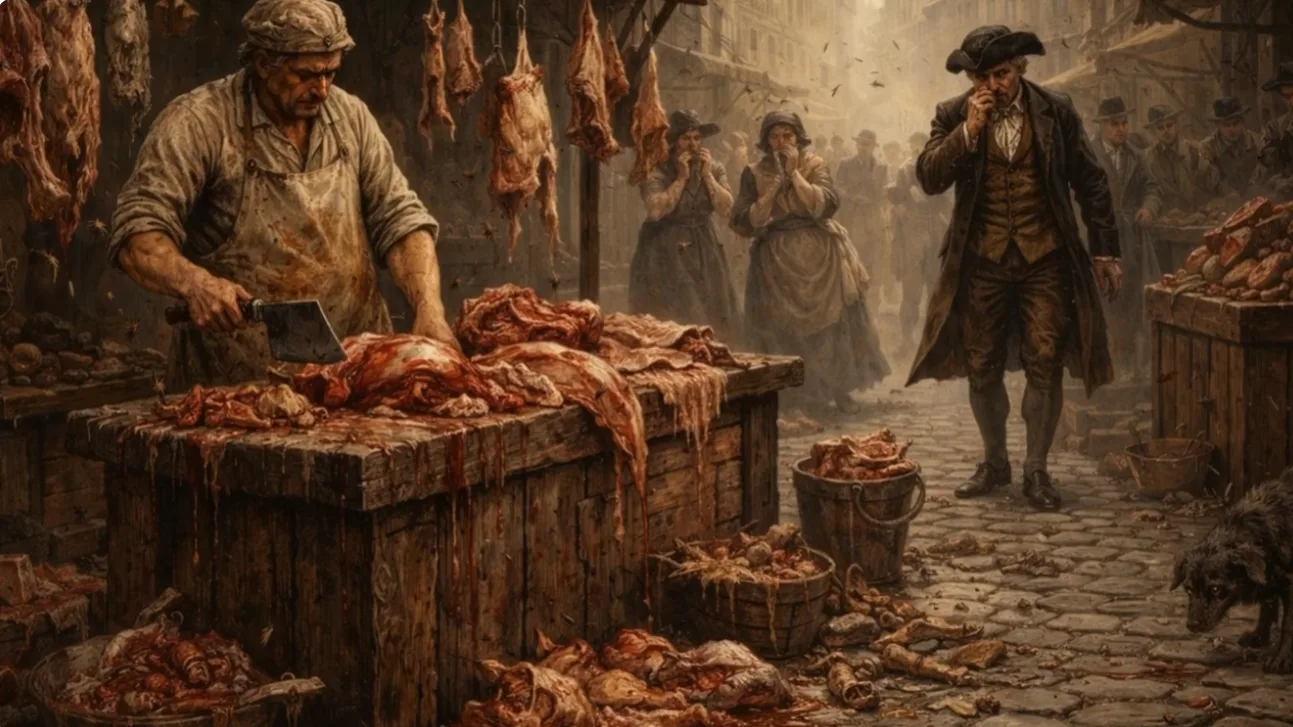
A butcher’s stall contains an especially potent mixture of smells.
There is fresh blood and older blood. Raw meat, fat, damp wood, metal, sawdust, flies and the bodies of customers pressed together in the street.
The visual description may be confronting, but smell removes the reader’s protective distance.
A photograph of raw meat remains outside the body.
An imagined metallic tang seems to enter the mouth and settle at the back of the throat.
That transition matters. The reader is no longer merely observing something unpleasant. The body begins to imitate the response it might have in the actual place.
The throat tightens.
The nose wrinkles.
The reader may breathe more shallowly without realising it.
Süskind turns description into a physical reaction.
Grenouille’s Inhuman Perception
Most people divide smells into broad categories: pleasant, unpleasant, familiar, strange, safe or dangerous.
Grenouille’s perception is vastly more detailed.
He mentally separates a smell into components and traces those components to their sources. Darkness barely limits him because scent provides its own map of the world.
This changes the way Süskind describes scenes.
Objects that might seem visually unimportant become prominent because of what they emit. People cannot hide behind appearance because Grenouille detects the physical reality beneath their clothing, cosmetics and manners.
His nose becomes a form of surveillance.
But Grenouille himself has no smell.
That absence is one of the novel’s most disturbing inventions. Other people sense something missing without necessarily understanding what it is. He occupies the world without announcing himself in the ordinary chemical language of a human body.
He can read everybody else.
They cannot read him.
Smell as Character, Not Decoration
Süskind’s descriptions are inseparable from Grenouille’s personality.
Another character might walk through the same market and notice colour, noise or social activity. Grenouille catalogues odours because scent is the organising principle of his consciousness.
This is the difference between useful sensory writing and decorative sensory writing.
A decorative smell has been added because the author remembered that scenes should involve five senses.
A meaningful smell exists because this particular character would notice it.
A baker notices yeast beginning to turn.
A nurse recognises infection beneath antiseptic.
A mechanic detects overheated wiring.
A child recognises the perfume worn by the person they fear.
The sensory detail should belong to the observer.
When every character notices smells in precisely the same way, we hear the author. When perception changes with the character, we enter a mind.
The Scent of Pure Beauty
Grenouille’s life changes when he encounters a scent he experiences as “pure beauty.”
What attracts him is not primarily a face, voice or personality. It is an odour he cannot bear to lose.
This reverses the usual hierarchy of attraction.
In most fiction, scent supports visual beauty. A beautiful person also possesses beautiful hair, clothing or perfume.
For Grenouille, smell is the beauty.
The person carrying it becomes almost secondary.
That makes his obsession particularly chilling. He does not recognise the complete humanity of the person whose scent entrances him. He experiences her as the source of something he wants to possess.
His gift reduces people to ingredients.
The more exquisitely he perceives their scent, the less morally he perceives them.
From Art to Control
Perfume is invisible, but it changes behaviour.
A person can smell innocent, wealthy, desirable, trustworthy or vulnerable without possessing any of those qualities. Grenouille eventually recognises that controlling scent means controlling how others interpret him.
This gives the novel its larger power.
Süskind is not only writing about fragrance. He is writing about image, manipulation and desire.
People believe their reactions arise naturally from within themselves. Grenouille understands that an external stimulus can manufacture those reactions.
Scent bypasses their conscious suspicion.
They feel affection and invent reasons for it afterwards.
Perfume becomes a lie the body believes before the mind can question it.
Beauty Layered Over Corruption
The novel constantly moves between exquisite perfume and physical decay.
Those opposites are not separate.
Beautiful fragrances may be produced through extraction, heat, fat, pressure and the destruction of their source. The finished perfume hides the labour and death from which it came.
Süskind makes beauty morally unstable.
A wonderful scent may conceal something appalling.
A foul environment may produce extraordinary perception.
A person without a scent may learn to manufacture an identity more convincing than a natural one.
This tension keeps the reader uncomfortable. We are invited to admire Grenouille’s genius while witnessing the monstrous purpose to which he applies it.
The perfume may be beautiful.
Its creation is not.
What Writers Can Learn from Süskind
The lesson is not to fill every scene with elaborate descriptions of smell.
The lesson is to treat scent as information.
A smell can reveal:
What happened here before the character arrived.
What somebody has attempted to conceal.
Who recently occupied the room.
Whether something is alive, decaying or dangerous.
Which memory the character has been avoiding.
How one person differs from everybody around them.
Smell is especially valuable because its source may remain invisible. A character can detect smoke before seeing flames, perfume after someone has left or damp soil before rain reaches the street.
It allows the environment to speak from beyond the edge of the scene.
Try It Yourself
Begin with a simple sentence:
He entered the kitchen.
Do not add visual adjectives.
Instead, choose one smell that reveals something has changed.
Perhaps the room smells of burnt sugar although nobody has cooked.
Perhaps bleach has been used recently and one patch of the floor is still wet.
Perhaps he recognises the hand cream his mother used, even though she has never visited this house.
Now add a second smell beneath the first.
The burnt sugar conceals gas.
The bleach cannot entirely cover blood.
The hand cream mingles with cigarette smoke, although his mother never smoked.
The first smell establishes the emotional expectation.
The second changes its meaning.
That is sensory storytelling.
Make the Reader Inhale
Patrick Süskind’s great achievement is not simply writing a novel containing many smells.
He imagines what it would mean to organise an entire consciousness through scent.
Paris becomes a layered atmosphere rather than a painted backdrop. Beauty becomes something that can be extracted. Identity becomes something that can be manufactured. Desire becomes something that can be chemically manipulated.
The reader is not allowed to remain a spectator.
We become, as the video suggests, a lung forced to inhale every beautiful and hideous thing Süskind places on the page.
That is exhausting.
It is claustrophobic.
And it is unforgettable.
Because when smell is used at the right moment, a writer does not merely decorate the room.
The writer opens a hidden passage into the reader’s memory and lets the story enter through it.
This is the first article in The Scent of a Story series.