
# Roald Dahl and the Visceral Prank
Eventually, every exploration of smell in fiction needs a palate cleanser—someone who doesn’t treat scent like a gothic obsession or a doorway into buried grief.
Enter Roald Dahl.
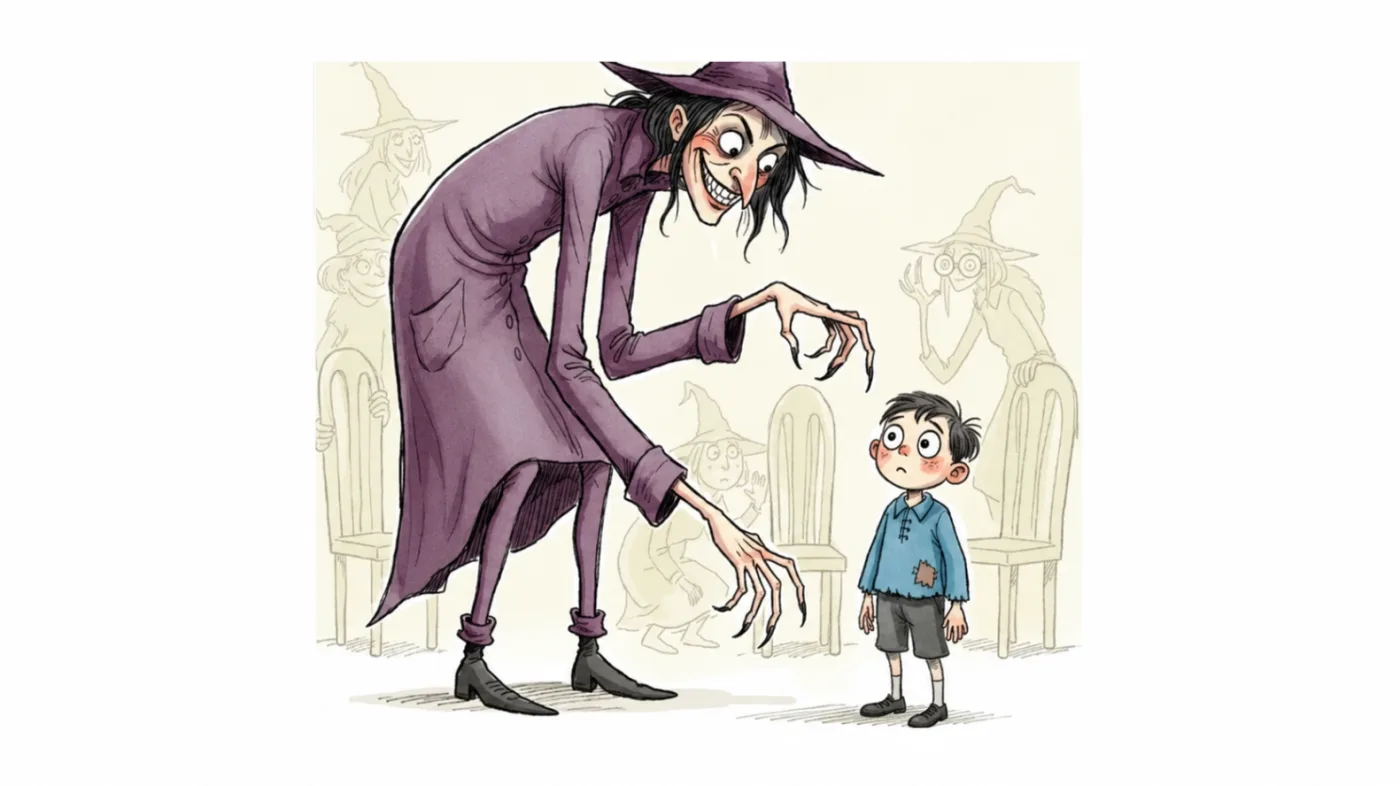
In his 1983 children’s novel The Witches, Dahl uses smell like a wicked practical joke. He doesn’t slowly construct an elaborate atmosphere. He takes something familiar, flips its meaning and delivers the result with such revolting confidence that the reader’s nose wrinkles almost automatically.
His witches can identify children by their smell. But the cleaner the child, the more disgusting the scent becomes to them. What smells like soap or fresh laundry to us smells like dogs’ droppings to a witch.
It is childish. It is grotesque. It is very funny.
It is also an extremely efficient piece of writing.
The Visceral Prank
Dahl understands that disgust doesn’t require a lengthy explanation. It only requires the right comparison at precisely the right moment.
A writer could tell us that witches possess an unusually powerful sense of smell. That would communicate the necessary information, but it would remain abstract. We would understand the witches intellectually without experiencing their world.
Dahl instead gives their sense of smell a revolting object.
Dogs’ droppings are immediate. Most readers know the smell, the physical reaction it produces and the instinctive desire to move away from it. The comparison therefore arrives with its own memory already attached.
Dahl doesn’t need to manufacture the sensation. The reader supplies it.
That is the visceral prank: he plants a disgusting idea in the mind and lets the reader’s sensory memory finish the sentence.

Reverse the Sensory Script
The cleverest part of the device is not simply that the smell is disgusting. It is that Dahl reverses the meaning of cleanliness.
In ordinary life, a clean child is considered safe, healthy and socially acceptable. Soap is associated with care. Fresh laundry suggests home. Bathing removes unpleasant smells.
Inside the witches’ sensory world, however, cleanliness makes a child easier to detect.
The safer the child appears to us, the more danger that child is in.
This reversal changes something ordinary into a warning signal. A bath is no longer merely a bath. Soap becomes a beacon. Freshly washed skin becomes evidence that can lead a predator directly to its prey.
That is how Dahl uses smell to reshape the logic of his fictional world. He doesn’t add scent as decoration. He turns it into a rule with consequences.
Disgust Creates Instant Participation
Disgust is one of the most physical reactions a writer can provoke. Readers may understand sadness from a distance, but a disgusting smell encourages the body to participate.
The nose wrinkles. The mouth tightens. The reader may lean away from the page despite knowing that no actual smell is present.
This is one reason Dahl’s grotesque comparisons work so well for younger readers. They convert fear into something tangible and slightly ridiculous. The witches remain dangerous, but the disgusting joke gives the reader a way to approach that danger.
Humour doesn’t remove the threat. It makes the threat memorable.
A frightening creature that merely “smells children” is a plot device. A frightening creature that thinks children stink of dogs’ droppings is an image a reader may remember for decades.
Smell Reveals Point of View
Sensory description is never completely neutral. What a character notices—and how that character interprets it—tells us who they are.
A baker and a starving traveller will not experience the smell of bread in the same way. A child may associate antiseptic with a painful hospital visit, while a doctor associates it with order and safety.
In The Witches, the reversed smell tells us that witches do not merely look different beneath their disguises. They experience humanity differently.
A child is not innocent or lovable to them. A child is offensive.
The smell therefore establishes an emotional boundary between the witches and everyone else. It shows us, in one disgusting comparison, that their values and instincts are fundamentally hostile to ours.
Dahl uses a nose to perform work that another writer might attempt through paragraphs of explanation.
Why the Joke Works
The comparison succeeds because it contains three elements:
First, it is familiar. Readers already possess a sensory memory connected to the smell.
Second, it is unexpected. Clean children and animal droppings do not ordinarily belong in the same sentence.
Third, it matters to the story. The smell can expose a child’s presence and place that child in danger.
Remove any one of these elements and the effect becomes weaker.
A familiar but predictable smell becomes ordinary description. An unexpected smell with no narrative consequence becomes a random joke. A plot-relevant smell that the reader cannot imagine remains abstract.
Dahl combines recognition, surprise and danger in one efficient sensory detail.
Try It Yourself: Reverse a Familiar Smell
Choose something normally associated with comfort:
Fresh bread Coffee Soap Cut grass A parent’s perfume Rain on warm pavement
Now place it inside the perception of someone who experiences it differently.
To most people, the room smelled of warm bread. To the prisoner, it smelled like the morning before every interrogation.
The coffee smelled rich and dark. She smelled only the hospital waiting room where she had drunk cup after cup.
His coat smelled freshly washed. To the tracking creature, that sharp cleanliness shone like a flare.
The objective is not simply to find a stranger adjective. Change what the smell means.
Ask three questions:
- Who is smelling it?
- What memory or instinct does it activate?
- What action does the smell provoke?
If the scent changes nothing, it may be decoration. If it changes the character’s understanding, emotion or behaviour, it belongs in the scene.
The Shortest Route to the Imagination
Dahl doesn’t need three pages of perfumed prose. He needs one perfectly disgusting comparison delivered at exactly the right time.
That economy is part of his genius.
He understands that smell is among the shortest routes into a reader’s imagination because the reader already carries an enormous private archive of scents. The writer merely supplies the trigger.
With the witches, that trigger is comic, repulsive and dangerous at once. It tells us how the creatures hunt, how they perceive children and how profoundly alien their instincts are.
The result is more than a joke about dogs’ droppings. It is a demonstration of how one sensory reversal can establish character, danger and an entire supernatural rule.
Patrick Süskind builds a cathedral out of scent.
Roald Dahl leaves something horrible on the doorstep, rings the bell and runs away laughing.
Both make the reader inhale.
This is the second article in The Scent of a Story series.