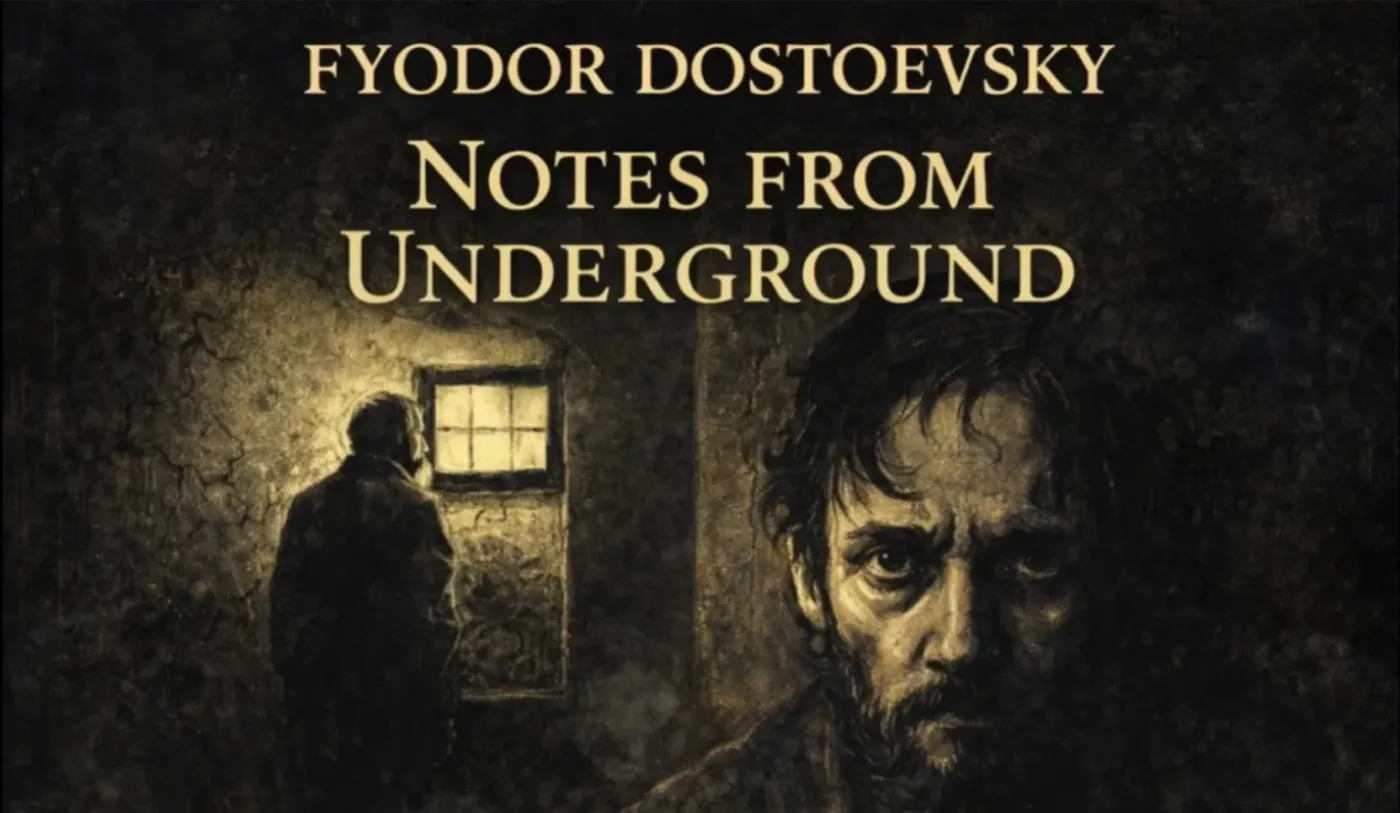
How Dostoevsky traps us inside a brilliant, spiteful mind—and makes its contradictions feel uncomfortably familiar.
The Sense of the Mind
Writing does not only put pictures into our imagination. At its most powerful, it reaches further—into the private machinery of the mind.
A carefully chosen voice can create discomfort, suspicion, empathy or guilt without anything physically happening to the reader. The story stops being something we merely observe. Our own thoughts become part of its construction.
Great writers understand this. They do not simply tell us what a character feels; they manipulate the way we think and feel.
In this Writer Mind Games series, I examine how remarkable authors achieve that effect: the device they use, the reaction it triggers and what other writers can learn from it.
Kafka disturbed our sense of reality. Agatha Christie made us suspicious of every detail.
Fyodor Dostoevsky does something more invasive.
He locks us inside a mind we may dislike—and then quietly shows us the parts of ourselves already living there.
Fyodor Dostoevsky and Notes from Underground
Published in 1864, Notes from Underground is narrated by an unnamed, isolated former civil servant living in St Petersburg.
He is usually known simply as the Underground Man.
He is intelligent, articulate and painfully self-aware. He is also bitter, spiteful, vain, self-destructive and determined to contradict not only society, but himself.
He does not ask us to admire him.
He almost dares us to despise him.
But before we can comfortably judge him, he begins explaining himself—and some of his explanations feel disturbingly familiar.
The Trigger: “I Am a Sick Man”
The book begins:
“I am a sick man … I am a spiteful man. I am an unattractive man. I believe my liver is diseased.”
There is no scenery. No introduction. No polite invitation into the story.
We are dropped immediately into a confession.
The sentences are short, blunt and almost aggressive. The Underground Man announces his sickness, spite and unattractiveness before anyone else can accuse him of them.
It feels brutally honest.
Yet almost immediately, he begins questioning, qualifying and contradicting what he has just said. He claims to understand himself while demonstrating that he does not. He boasts about his intelligence, then describes behaviour that is irrational and humiliating.
We cannot decide whether he is confessing, performing or attacking.
That uncertainty is the doorway into his mind.

The Trick: Confession as a Weapon
Most narrators try to earn the reader’s trust.
The Underground Man seems determined to destroy it.
He admits to thoughts that people ordinarily conceal: petty resentment, imagined humiliation, vindictive fantasies and the desire to wound others simply because he feels wounded himself.
But his honesty does not make him reliable.
That is Dostoevsky’s trick.
The Underground Man uses confession as both revelation and defence. By exposing his worst qualities voluntarily, he tries to remain in control. If he condemns himself first, perhaps no one else can hurt him with the same accusation.
His honesty becomes a suit of armour.
It also becomes a weapon aimed at the reader.
He repeatedly addresses an imagined audience—questioning our reactions, anticipating our objections and mocking the moral superiority from which we might judge him.
Every time we attempt to step back, he notices us.
Every time we form an opinion, he argues against it.
The fourth wall does not simply break. It disappears.
The Reader Goes Underground
A conventional story allows us to watch a troubled character from a safe distance.
Dostoevsky removes that distance.
The Underground Man does not merely report his thoughts. He performs them as they occur. One idea provokes another. Certainty becomes doubt, doubt becomes resentment, and resentment circles back into self-accusation.
His mind does not travel in a straight line.
It spirals.
He recalls a humiliation, imagines how others perceived it, rehearses the revenge he should have taken, despises himself for failing to act—and then takes pride in being intelligent enough to understand his own failure.
Every insight creates another form of paralysis.
The more clearly he sees himself, the less capable he becomes of changing.
The Feeling: The Heavy Guilt

Reading the Underground Man can feel strangely exhausting.
His resentment has weight. His shame has weight. Even his intelligence becomes heavy because it supplies him with endless new reasons to remain bitter.
This creates what I call the Heavy Guilt.
It is not simply guilt over one bad action. It is the oppressive feeling of being made conscious of thoughts we would rather deny having.
Who has not replayed an argument and invented the devastating reply that arrived several hours too late?
Who has not imagined being judged by people who may not have been thinking about us at all?
Who has not refused something sensible merely because another person expected us to accept it?
The Underground Man takes these recognisable impulses and pushes them towards their ugliest extremes.
We recoil from him—and then recognise the machinery.
That recognition is where the heaviness begins.
Intelligence Without Escape
The Underground Man understands many of his own problems.
That should help him escape them.
Instead, his intelligence gives those problems a more elaborate vocabulary.
He analyses every possible motive until action becomes impossible. If he performs a kind act, perhaps he only wants admiration. If he apologises, perhaps he is attempting to appear noble. If he loves someone, perhaps he merely wants power over them.
Every decent impulse can be dismantled and accused of selfishness.
His self-awareness becomes a trap.
Dostoevsky challenges the comforting belief that understanding ourselves automatically makes us better. Sometimes we use intelligence not to change, but to construct more convincing excuses for remaining exactly as we are.
The Underground Man does not lack insight.
He lacks a way out.
The Mirror Turns Towards Us
It would be easy to dismiss the narrator as an unpleasant curiosity: a bitter man hiding from life and writing attacks against an imaginary audience.
But Dostoevsky does not allow that comfortable separation.
The Underground Man exaggerates ordinary human contradictions. He wants connection but rejects people. He wants dignity but engineers his own humiliation. He despises cruelty while behaving cruelly. He insists upon his independence while remaining obsessed with the opinions of others.
He is not frightening because he is completely alien.
He is frightening because his weaknesses are recognisable.
The story becomes a mirror—not one that reflects our face, but one that catches the thoughts standing behind it.
What Writers Can Learn from Dostoevsky
You do not need a narrator as extreme as the Underground Man to create psychological intimacy.
You need contradiction.
- Let the character admit something most people would hide.
- Allow honesty to serve a selfish purpose.
- Make the character aware of a flaw but unable to correct it.
- Let one thought contradict the thought immediately before it.
- Have the character anticipate the reader’s judgement.
- Reveal the vulnerability beneath the hostility.
- Give the reader one uncomfortable point of recognition.
A psychologically convincing character does not require a perfectly consistent personality.
Real people are rarely consistent.
We want attention and privacy. Freedom and approval. Honesty and protection. We resent people for overlooking us, then push them away when they come close.
Contradiction is not necessarily a failure of characterisation.
Sometimes it is the character.
Your Turn
Write a confession from someone who insists they feel no guilt.
Let the character explain why their actions were completely justified.
Then allow one unnecessary detail to slip through—a detail revealing that they have replayed the event many times.
Have them correct themselves. Let them accuse the imagined reader of misunderstanding. Make them offer an explanation that creates more suspicion than it removes.
Finally, give them one sentence of genuine self-knowledge.
Then make them retreat from it.
If the reader feels judgment, sympathy and recognition at the same time, you have created Dostoevsky’s mind game.
You have made the reader uncomfortable with the character.
And perhaps, for a moment, uncomfortable with themselves.
That is the Heavy Guilt.
Writer Mind Games explores how celebrated authors use language, structure and perspective to change what happens inside the reader’s mind.
Previously: Agatha Christie and the Analytical Itch Next: Ursula K. Le Guin and the Big Realisation