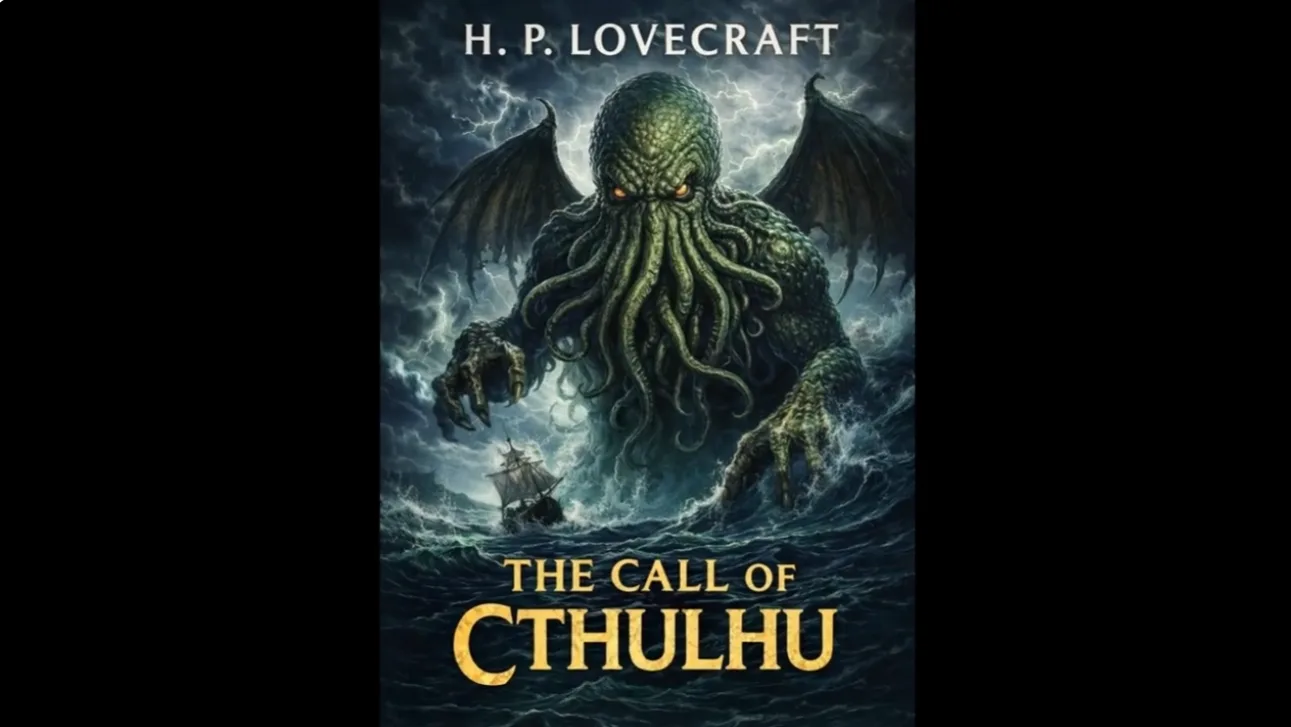
What if the universe is not hostile to humanity—but so enormous and indifferent that it barely notices we exist?
The Sense of the Mind
Most monsters become less frightening when we can see them clearly.
Once the creature steps into the light, the imagination stops working. We can count its teeth, estimate its size and begin considering how it might be escaped or destroyed.
H. P. Lovecraft understood that the most powerful horror may begin where description fails.
In The Call of Cthulhu, the danger is not simply an ancient creature sleeping beneath the ocean. It is the discovery that human history occupies an insignificant corner of a reality far older, stranger and less comprehensible than we believed.
The narrator assembles fragments of evidence.
A disturbing sculpture.
A professor’s papers.
Nightmares experienced by artists around the world.
A police raid on a ritual.
A sailor’s account of an island that should not exist.
Each fragment points towards something larger. Yet the closer we move towards understanding it, the less stable reality becomes.
The mind reaches for a complete picture.
Lovecraft ensures it never finds one.
That is the Cosmic Crush: the sensation of human importance collapsing beneath the unimaginable scale of the universe.
H. P. Lovecraft and The Call of Cthulhu
Written in 1926 and published in Weird Tales in 1928, The Call of Cthulhu is presented as a collection of documents left behind by Francis Wayland Thurston.
After the death of his great-uncle, Professor George Gammell Angell, Thurston discovers notes concerning a mysterious cult and a strange clay relief.
The sculpture depicts something difficult to classify: part humanoid, part dragon and part octopus.
At first, it appears to be the bizarre invention of a troubled artist.
Then connections emerge.
Similar images appear in accounts separated by geography, culture and time. People who could not have communicated with one another dream of immense cities, unnatural landscapes and a repeated phrase associated with Cthulhu and R’lyeh.
The evidence suggests that the sculpture is not an invention.
It is a memory.
Something ancient is impressing itself upon human minds from beneath the sea.
The Trigger: Ignorance as Mercy
Lovecraft begins with an extraordinary proposition:
“The most merciful thing in the world, I think, is the inability of the human mind to correlate all its contents.”
Knowledge is usually presented as liberation.
We solve the mystery, expose the deception and replace fear with understanding. Darkness is frightening because we do not know what it contains. Turn on the light, and safety returns.
Lovecraft reverses that promise.
The facts are survivable only while they remain disconnected.
A strange dream is merely a dream. An ancient carving is an archaeological curiosity. A sailor’s delirious account is the product of trauma.
But place these fragments beside one another and a pattern appears.
The pattern is worse than uncertainty.
In Lovecraft’s universe, ignorance is not weakness. It is a protective barrier preventing the human mind from recognising its true position.
Understanding does not rescue us from the darkness.
Understanding reveals how much darkness surrounds us.
The Trick: Strategic Vagueness
Lovecraft does not leave Cthulhu completely undescribed.
We receive suggestive components: tentacles, claws, scales, wings and an enormous vaguely human form.
But these details refuse to combine into a stable body.
They belong to different categories of creature. Sea life, reptile, dragon and giant are layered together, each comparison interfering with the last.
Lovecraft then undermines his own description. Witnesses struggle for words. The creature’s form seems incompatible with familiar matter. The architecture surrounding it violates expected angles and dimensions.
Our minds attempt to complete the image.
Every attempt fails.
This failure becomes the horror.
A clearly described monster remains contained inside its physical outline. Cthulhu seems too large and contradictory to fit within one. The imagination keeps redrawing him without reaching a final version.
Strategic vagueness does not mean supplying no information.
It means supplying precisely enough information to make the reader attempt an impossible construction.
Making the Reader Feel Small
Cosmic horror changes the scale of fear.
A murderer threatens one life. A war threatens nations. An asteroid threatens the human species.
Cthulhu threatens the belief that humanity matters.
Lovecraft’s ancient beings existed before human civilisation and may remain after it disappears. Our religions, governments, discoveries and achievements occupy only a moment within their vast chronology.
We are not their chosen enemies.
We may be no more significant to them than insects disturbed when a sleeping person turns over.
That indifference is more unsettling than hatred.
A hateful monster recognises our existence. It directs attention towards us. However terrible its intentions, we matter enough to become its target.
Cosmic indifference offers no such reassurance.
The universe does not need to defeat humanity.
It merely continues.

The Architecture That Cannot Exist
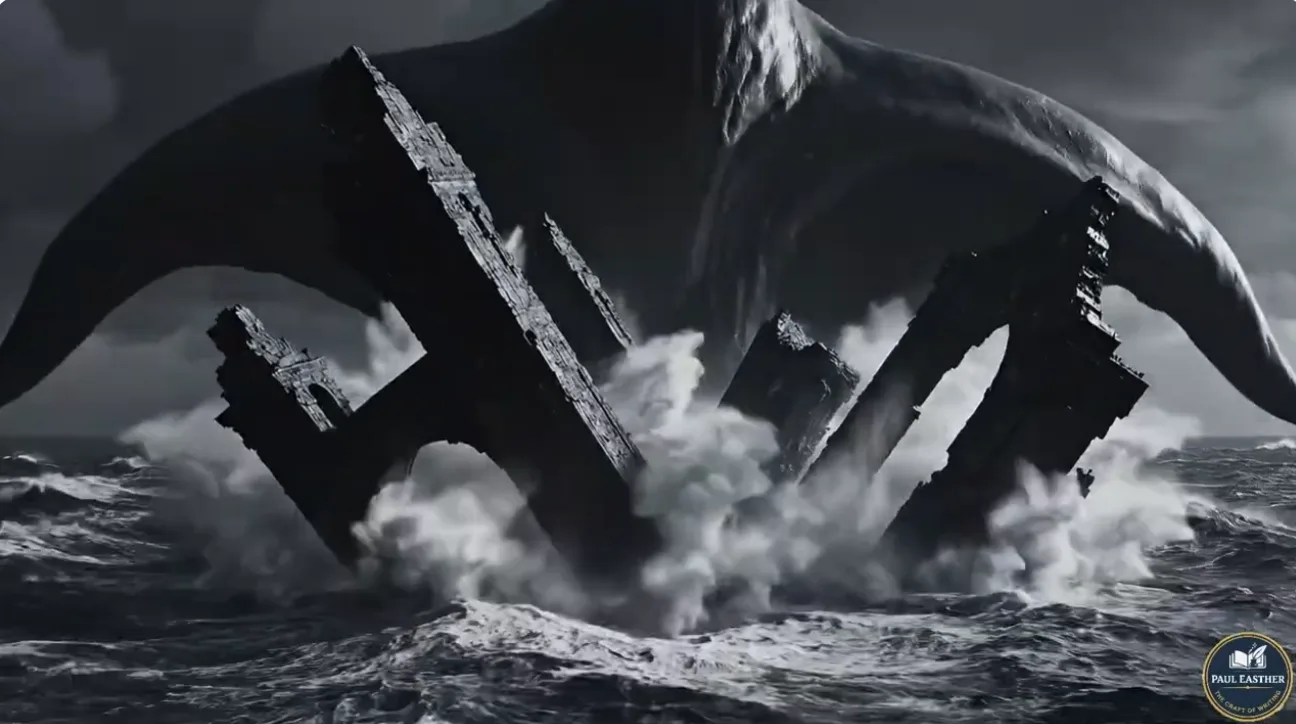
When sailors discover the risen city of R’lyeh, its architecture does not obey familiar geometry.
Surfaces appear horizontal and vertical at the same time. Angles behave incorrectly. A doorway’s proportions and position cannot be reconciled with ordinary space.
Lovecraft uses geometry to attack the reader’s’s most basic trust in perception.
We rely upon space unconsciously. Walls meet floors. Near and far remain distinct. An object cannot occupy two contradictory orientations at once.
R’lyeh appears to operate according to rules the human mind was not designed to process.
Again, description creates a failed mental image.
Try to imagine an angle behaving as two different angles simultaneously. The harder you concentrate, the more clearly you encounter the limitations of your own perception.
Lovecraft turns incomprehension into evidence.
The reader cannot picture R’lyeh because the city belongs to a reality beyond human geometry.
Or so the story persuades us to feel.
The Feeling: The Cosmic Crush
The Cosmic Crush arrives when the reader’s perspective suddenly expands.
The room in which we are reading seems smaller.
Human history seems shorter.
The night sky becomes less decorative and more like an opening onto distances our minds cannot comprehend.
We know intellectually that the universe is vast. Numbers tell us about billions of stars, immense distances and stretches of time preceding human existence.
But numbers can remain emotionally weightless.
Cosmic horror translates scale into vulnerability.
The stars are no longer distant lights. They become evidence of how little we can see. The ocean is no longer scenery. It becomes a covering beneath which entire histories might remain concealed.
Lovecraft gives enormity psychological pressure.
The universe seems to press down upon the reader.
Horror Built from Documents
Lovecraft strengthens the illusion by telling the story through reports, manuscripts, newspaper clippings and testimony.
No single witness understands the whole.
One person experiences the dream. Another studies the cult. Another encounters the impossible city. Thurston gathers their accounts after several of those people are dead.
This documentary structure makes the supernatural feel researched rather than invented.
It also turns the reader into another investigator.
We correlate the evidence alongside Thurston. Each connection increases our understanding and therefore increases the danger.
The structure fulfils the warning in the opening sentence.
The horror does not arrive because information is missing.
It arrives because scattered information has finally been assembled.
We participate in the act the story tells us is unsafe.
Curiosity becomes complicity.
When Vagueness Stops Working
Strategic vagueness is powerful, but easily misused.
Simply calling something “indescribable” does not automatically make it frightening. If readers receive no sensory foothold, they may imagine nothing at all.
Lovecraft provides fragments.
We see the distorted sculpture, smell the ancient stone, hear chanting and feel the wrongness of the city’s angles. Concrete details establish physical presence while the complete meaning remains unavailable.
The writer’s task is to control the boundary.
Describe enough for the reader’s imagination to begin working.
Withhold enough that it cannot finish.
The terror lives in that unfinished space.
The Prejudice Inside Lovecraft’s Darkness
Any honest discussion of Lovecraft must also acknowledge his virulent racism and xenophobia.
Those beliefs were not confined to his private correspondence. They entered his fiction through dehumanising descriptions, fears of racial mixing and the repeated association of foreign or non-white people with degeneration and secret corruption.
In The Call of Cthulhu, descriptions of cult participants draw upon those prejudices.
That presents modern writers with an important distinction.
We can study Lovecraft’s control of scale, fragmented evidence and implied horror without reproducing the idea that unfamiliar cultures or marginalised people are inherently monstrous.
Fear of the unknown can open the imagination.
Fear of other human beings can reduce it.
The technique remains valuable. The prejudice deserves recognition rather than imitation.
What Writers Can Learn from Lovecraft
Begin with something your viewpoint character cannot fully comprehend.
Do not show the entire threat immediately.
Offer one physical fragment: a footprint with the wrong number of joints, a sound continuing below the range of hearing, or a photograph containing a shape whose distance cannot be determined.
Then provide evidence from a second source.
Let the details agree in one respect and contradict each other in another. Agreement suggests that the threat is real. Contradiction suggests it cannot be contained by familiar categories.
Increase the scale gradually.
A local mystery might connect to an ancient record. The record might point towards a geological pattern. The pattern might suggest that the entire history of civilisation rests upon a mistaken assumption.
Most importantly, decide what the discovery destroys.
Does it challenge the character’s faith, identity, understanding of time or belief in human importance?
A large monster produces spectacle.
A large idea produces cosmic horror.
Your Turn
Write a scene in which a character discovers three unrelated pieces of evidence.
A child’s drawing.
A centuries-old map.
A signal recorded by a radio telescope.
Give each item one small feature in common.
Do not explain the connection immediately. Let the character dismiss the first coincidence, become unsettled by the second and understand just enough after the third.
Now describe the threat using only three concrete details.
Make those details difficult to combine.
Finally, ask what fact would be more frightening than the creature itself.
Perhaps it has always been present.
Perhaps it is not awake.
Perhaps the signal is not travelling towards Earth, but answering something transmitted from here.
Do not complete the picture.
Let the reader’s mind reach into the darkness and discover that it cannot find the edges.
That is the Cosmic Crush.
Not the fear that something enormous is watching us.
The fear that something enormous has no reason to.
Previously in Writer Mind Games: Octavia E. Butler and the Body Trap.
This concludes the eleven-part Writer Mind Games series.