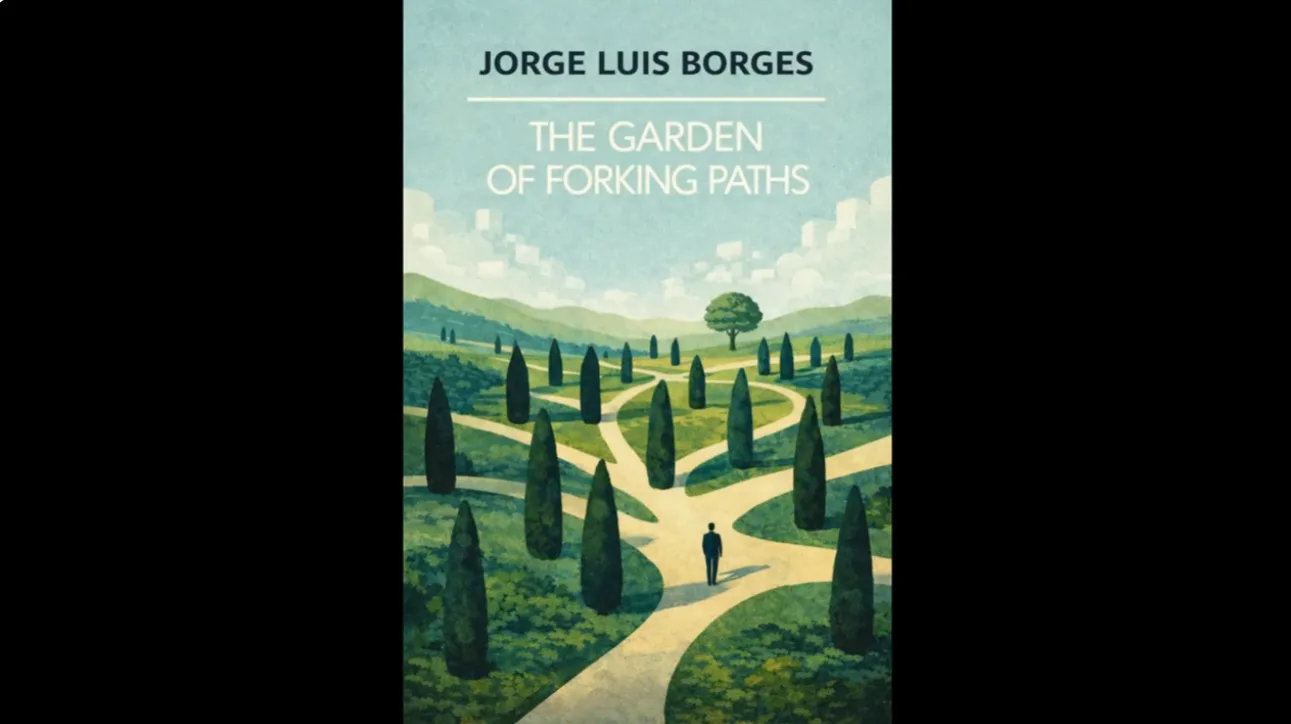
How one short spy story opens into a labyrinth containing every choice you might ever make.
The Sense of the Mind
Some stories feel larger than the number of pages containing them.
Jorge Luis Borges could create that sensation in the space another writer might need merely to introduce the characters.
He begins with something apparently manageable: a document, a murder, a library, a garden or an obscure historical mystery. Then the idea turns back upon itself. A book contains a world. That world contains another version of the book. A path divides, and each division produces further paths.
Before long, the reader is no longer standing outside the idea.
We are trapped inside it.
The story has not physically grown, yet our minds are struggling to hold an expanding structure of possibilities. We attempt to map it, realise that the map would need to include itself, and feel the walls of ordinary thought begin to bend.
This is Borges’s mind game.
He gives infinity a front door—and invites us inside.
Jorge Luis Borges and The Garden of Forking Paths
Published in 1941, The Garden of Forking Paths initially presents itself as an espionage story.
During the First World War, a Chinese professor named Yu Tsun is working as a spy for Germany. He discovers that a British intelligence officer is pursuing him and that his own capture is imminent.
Yu Tsun possesses one final piece of valuable information: the location of a British artillery park. He must somehow communicate its name to his German superiors before he is arrested or killed.
This creates the machinery of a conventional thriller. A hunted spy has limited time, an important secret and an enemy closing in.
But Yu Tsun’s escape brings him to the home of Dr Stephen Albert, a scholar who has studied the strange work of Yu Tsun’s ancestor, Ts’ui Pên.
Ts’ui Pên abandoned political power to undertake two apparently separate projects:
He would write an enormous novel.
He would construct an intricate labyrinth.
After his death, however, no physical labyrinth could be found. The novel appeared chaotic and contradictory. Characters died in one chapter and appeared alive in another. Events seemed to occur in incompatible ways.
Dr Albert has discovered the solution.
The novel and the labyrinth are the same object.
The Trigger: A Labyrinth of Labyrinths
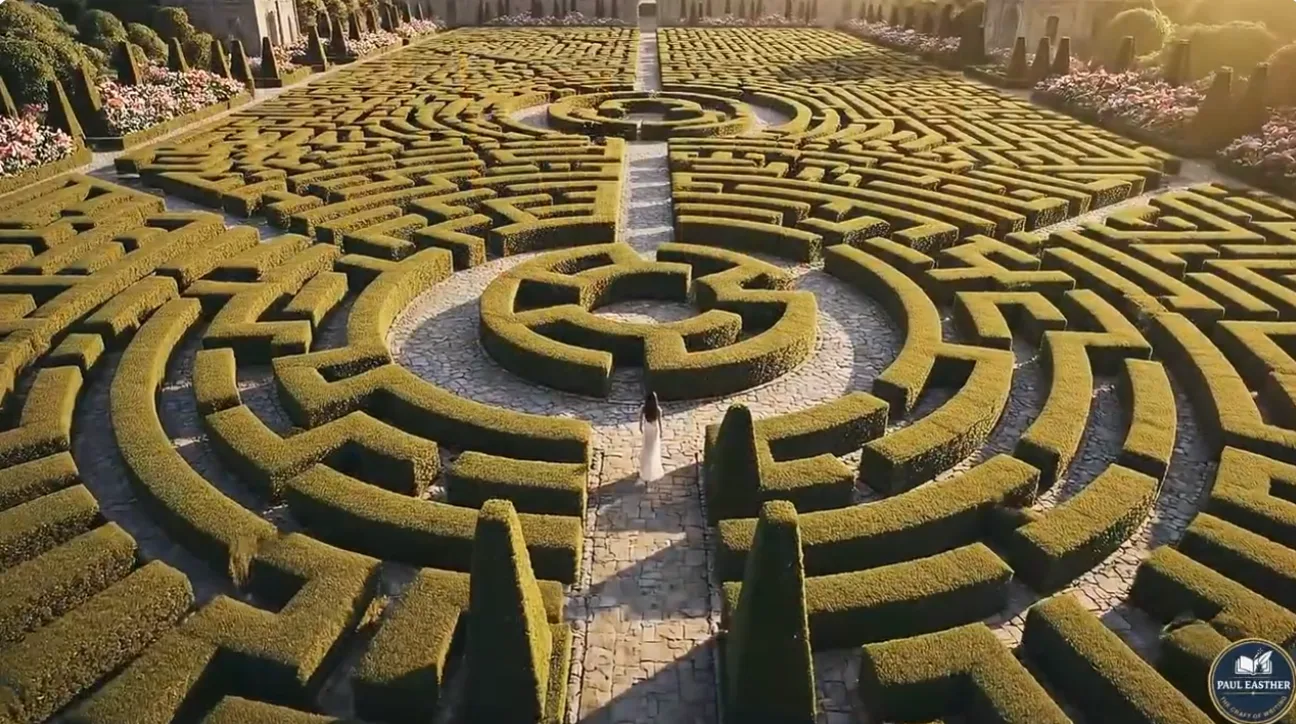
As Yu Tsun approaches Albert’s home, his thoughts begin expanding beyond the physical garden around him:
“I thought of a labyrinth of labyrinths, of one sinuous spreading labyrinth that would encompass the past and the future.”
At first, we picture hedges, corridors and branching paths.
Then the dimensions change.
This labyrinth does not merely occupy space. It encompasses time.
Every decision becomes a junction. Every possible outcome becomes another path. Each path contains further decisions, producing more futures, which divide again.
A conventional maze may be enormous, but it remains finite. Somewhere, even if we cannot see it, there is an outer wall.
Borges removes the wall.
The Trick: A Book That Contains Its Alternatives
Most stories discard possibilities.
A character reaches a crossroads and chooses left. The journey continues along that route, while the unwritten journey to the right disappears.
Borges asks: what if it does not disappear?
In Ts’ui Pên’s book, several outcomes can occur. A character may live in one chapter, die in another and meet a different version of himself somewhere else.
These are not simply drafting alternatives from which the author forgot to select. They are simultaneously valid branches of time.
Dr Albert explains that time continually divides towards innumerable futures. In one future, two people may be enemies. In another, they may be friends. Elsewhere, they may never meet.
The novel is therefore not merely describing a labyrinth.
Its structure is the labyrinth.
Borges places the reader inside an idea that reproduces itself. The fictional scholar explains the fictional novel, which explains the story we are currently reading, which makes us reconsider the decisions occurring within that story.
Like a set of Russian nesting dolls, each level contains another version of the same pattern.
But unlike the dolls, there may be no smallest figure at the centre.
When a Story Becomes a Machine for Thinking
Borges often wrote in the tone of an essayist, historian or librarian.
He referred to manuscripts, scholars, dates and forgotten books. Some sources were real. Others were invented. He presented impossible concepts with the dry confidence of someone cataloguing documents in an archive.
That scholarly voice makes the fantastic idea feel disturbingly plausible.
If Borges had described branching time in the language of spectacle, we might admire it as an imaginative fantasy. Instead, he offers it as an intellectual discovery—as though the evidence has always existed in an obscure volume we simply neglected to read.
The reader begins testing the proposition.
What if every choice really does create alternatives?
What if our lives are only one route through a structure containing all the lives we might have lived?
Somewhere, did we accept the invitation we refused here? Speak the words we swallowed? Avoid the accident? Marry someone else? Remain in the town we left?
The concept moves out of the story and begins multiplying inside our own history.
That is when the maze becomes personal.
The Feeling: The Mental Maze
Borges produces a distinctive kind of intellectual breathlessness.
We understand the first division easily enough. One path becomes two.
But each of those paths divides again. Two become four, four become eight, and the multiplication continues through every moment of every life.
Our minds attempt to visualise the total structure.
They cannot.
This failure is not frustrating in the ordinary sense. It produces wonder. We glimpse the shape of an idea too large to hold, like looking through a telescope at light that began travelling before human beings existed.
This is the Mental Maze.
The reader does not become lost because Borges has explained too little. We become lost because we understand enough to recognise the enormity of what cannot be mapped.
He brings us to the edge of comprehension and lets us look over.
Borges’s Other Infinities
The branching novel in The Garden of Forking Paths belongs to a larger pattern in Borges’s work.
In The Library of Babel, he imagines a universe composed of galleries containing every possible book. Somewhere within that library is an accurate account of your life. Elsewhere are millions of nearly identical versions containing a single error, a different ending or nothing but meaningless combinations of letters.
In The Book of Sand, he imagines a book whose pages have no beginning or end. Every attempt to find the same page again fails because infinitely many pages appear between any two points.
These objects are impossible, but Borges describes them with such precision that the mind tries to construct them.
A library containing every possible book.
A book containing infinitely many pages.
A novel containing branching versions of every possible future.
Each concept creates a logical doorway. Once we step through, the idea expands faster than our imagination can follow.
Why the Human Story Still Matters
An ingenious concept alone can feel like a clever diagram.
Borges anchors his philosophical puzzle inside a story of urgency, violence and moral compromise.
Yu Tsun is not calmly contemplating infinity from a comfortable chair. He is running for his life. He must make a terrible decision in order to transmit his military secret.
That choice gives the idea of branching futures emotional force.
We understand that another Yu Tsun might choose differently. Another version might refuse his mission. In another path, he and Dr Albert may become friends. In still another, the pursuing officer may arrive too late—or never arrive at all.
Yet the Yu Tsun we follow must inhabit the consequences of one path.
The infinite possibilities do not free him from responsibility.
They make his particular choice feel more haunting.
Among countless imaginable futures, this is the one he creates.
What Writers Can Learn from Borges
Begin with a question that cannot be answered simply.
What if a person could remember every moment of their life?
What if a map became as large as the country it represented?
What if a book accurately described the reader’s next action?
Then give that abstract question a physical form.
Place it inside a manuscript, photograph, machine, building or ordinary object. Let the character touch it, investigate it or become threatened by it.
Next, allow the idea to repeat at different levels of the story.
A character discovers a book about a person discovering a book. A map contains the room in which the map is being examined. A prediction causes the event it claims merely to foresee.
Each repetition should enlarge the question rather than merely repeat the trick.
Finally, anchor the concept in a human decision.
Infinity may astonish the mind, but a single irreversible choice reaches the heart.
Your Turn
Write down one impossible philosophical question.
Now resist the urge to explain it.
Invent an object that embodies it.
Perhaps it is a clock that records time not yet lived, a family photograph that adds people before they are born, or a corridor that becomes longer whenever someone remembers the room at its end.
Place the object in the hands of someone who urgently needs something.
Then ask what choice the object forces them to make.
If the idea works, the reader will understand the immediate problem while sensing something much larger unfolding behind it.
They will try to map its implications.
The paths will divide.
And somewhere between one possibility and the next, the story will become a Mental Maze.
Previously in Writer Mind Games: Haruki Murakami and the Dream Walk.
Next: Ken Kesey and the Mental Fog.