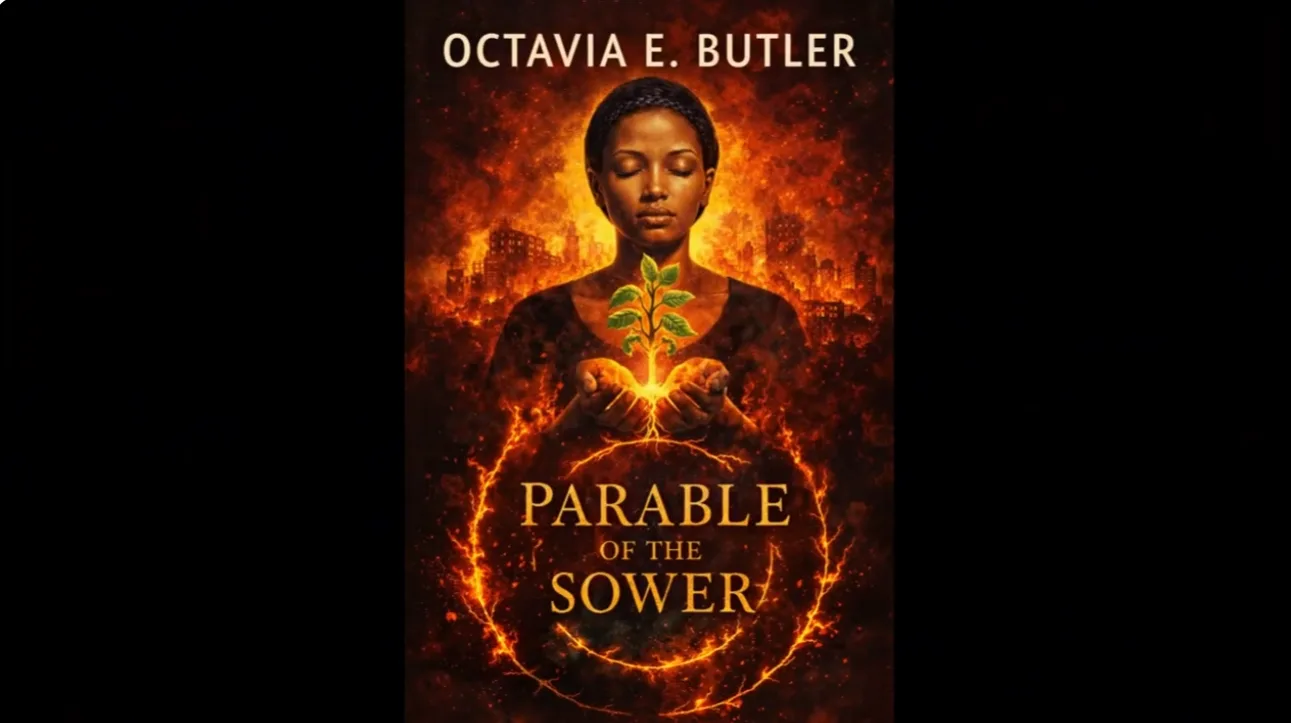
What happens when another person’s wound becomes something your own body cannot ignore?
The Sense of the Mind
Most stories ask us to care about a character’s pain.
Octavia E. Butler removes the element of choice.
In Parable of the Sower, Lauren Olamina suffers from hyperempathy—or “sharing”—a condition that causes her to experience sensations she witnesses in other people.
If she sees someone struck, her own body registers the blow.
If she watches someone bleed, pain moves across the boundary between their skin and hers.
The injury may not physically belong to Lauren, but the suffering becomes real enough to incapacitate her.
Butler places this condition inside a collapsing society where violence is common, trust is dangerous and survival may require hurting someone before they hurt you.
Compassion is no longer simply a virtue.
It is a physical vulnerability.
And because Butler describes Lauren’s reactions through the body, the reader can begin to flinch with her.
That is the Body Trap.
Octavia E. Butler and Parable of the Sower
Published in 1993, Parable of the Sower imagines a near-future United States destabilised by climate change, extreme inequality, corporate exploitation, addiction and failing public institutions.
Lauren is a Black teenager living with her family inside a walled community near Los Angeles.
The wall offers limited protection from the desperation outside. Water is expensive. Emergency services cannot be relied upon. Homeless families travel the roads. Drug-fuelled violence and fire threaten the fragile order Lauren’s neighbours have built.
Many of the adults around her hope conditions will improve.
Lauren studies the evidence and reaches a harsher conclusion.
The wall will eventually fall.
She quietly prepares for that day, gathering knowledge, supplies and survival skills. At the same time, she develops Earthseed, a belief system founded upon one unavoidable principle:
God is Change.
Lauren understands that survival will depend upon adaptation.
But her hyperempathy makes adapting to violence uniquely dangerous.
The Trigger: Collecting Other People’s Misery
Travelling through a landscape filled with suffering, Lauren observes:
“I couldn’t help seeing—collecting—some of their general misery.”
The word collecting changes the sentence.
Lauren does not merely notice misery. She accumulates it.
Every injured stranger adds something to the burden carried by her own nervous system. Pain does not remain safely contained within the person to whom it happened.
It crosses over.
Butler does not romanticise this experience. Hyperempathy does not make Lauren saintly, gentle or incapable of difficult decisions. In her world, unprotected sensitivity can get a person killed.
She must learn when to look away.
She must sometimes act despite knowing that another person’s pain may immediately become her own.
Empathy and self-preservation pull in opposite directions.
Neither can be discarded.
The Trick: Turning Compassion into Sensation
Writers frequently communicate pain by naming it.
A character is hurt. The wound is terrible. The agony is unbearable.
Butler works through physical specificity.
Pain has pressure, temperature, location and rhythm. It throbs, burns, pulls, pierces or spreads. Muscles tighten. Balance disappears. Breath becomes difficult.
This sensory language recruits the reader’s own body.
We know the difference between a sharp pain and a dull one. We remember the instinct to protect an injured limb, even when the injury belongs to a fictional character.
Lauren’s condition intensifies that response because it creates a chain:
One character is injured.
Lauren witnesses the injury.
Her body duplicates the sensation.
The reader imagines Lauren feeling it.
Pain passes from body to body until it reaches us.

The Body Believes What the Mind Sees
Lauren’s condition is described as a delusional or psychosomatic syndrome associated with the drug her mother used during pregnancy.
She is not physically receiving another person’s wound.
Her brain is producing the experience of that wound in her body.
That distinction offers little comfort when the pain arrives.
The body does not require an actual cut before generating suffering. Perception is enough.
Butler uses this to unsettle the familiar division between “real” and “imagined” pain. If a sensation can disable a person, alter their decisions and endanger their life, calling it imaginary does not make it harmless.
Lauren knows that what she experiences originates within her own nervous system.
She cannot reason it away.
The body has accepted the image as evidence.
Now it demands a response.
The Feeling: The Body Trap
The Body Trap begins when reading stops feeling entirely mental.
A violent scene makes us tense our shoulders. We become aware of vulnerable parts of our own bodies. We may recoil before the blow described on the page has landed.
Butler turns anticipation into part of the pain.
Lauren does not only fear being injured. She fears witnessing injury. A fight between two strangers can disable her. Someone else’s wound may leave her vulnerable to attack.
There is no safe position.
Looking exposes her to suffering.
Looking away exposes her to danger.
The reader shares this alertness. Every injured body in the landscape becomes a possible threat to Lauren’s body. Compassion and fear begin firing together.
We do not observe the broken world from a comfortable distance.
Butler makes distance itself collapse.
Empathy as a Survival Disadvantage
Stories often present empathy as an uncomplicated strength.
The compassionate person understands others, builds trust and makes morally superior choices.
Butler asks what empathy costs.
Lauren lives in a world where violence can be necessary for survival. If she injures an attacker, she may experience the attacker’s pain. If she witnesses death, the shared sensation can leave her unconscious and defenceless.
An enemy who discovers her condition could exploit it.
Her empathy does not automatically prevent cruelty around her. It does not repair institutions, produce food or stop armed people from attacking.
At times, it makes survival harder.
Yet Lauren’s sharing also prevents her from treating suffering as abstraction. She cannot reduce injured people to background scenery or acceptable losses. Their pain enters her body and insists upon recognition.
The condition is both disability and moral pressure.
Butler refuses to simplify it into either a blessing or a curse.
It is a vulnerability Lauren must carry intelligently.
The Paradox of Necessary Violence
Lauren’s world does not permit moral purity.
She cannot promise never to cause pain. Such a promise might sacrifice not only her life, but the lives of people depending upon her.
This produces the novel’s sharpest tension.
Lauren may need to defend herself while knowing she will share some part of the damage she causes. Violence becomes physically reciprocal even when it is morally justified.
The person inflicting pain cannot remain untouched.
That reciprocity exposes something ordinarily hidden. Violence transforms the person committing it as well as the person receiving it—even when their injuries are not identical.
Lauren’s condition makes that transformation immediate and bodily.
Every act has two targets.

Feeling Pain Is Not the Same as Helping
Butler also separates empathy from effective action.
Feeling another person’s suffering does not automatically reveal how to stop it. Lauren can experience someone’s pain and still lack medicine, safety or resources.
Sometimes the only available choices are inadequate.
This distinction matters because empathy is often praised as though emotional identification solves the underlying problem.
It does not.
Pain can overwhelm a person until they become incapable of acting. Survival requires Lauren to combine sensitivity with planning, knowledge, boundaries and practical judgment.
Compassion must become organised.
This principle extends beyond the fictional condition. A reader can be moved by suffering without changing anything. A community can express concern while preserving the structures that caused the harm.
Feeling is an opening.
It is not the completed work.
What Writers Can Learn from Butler
Begin with the emotional connection you want readers to experience.
Then give it a physical mechanism.
If a character feels another person’s fear, perhaps their breathing changes. If guilt connects two people, perhaps an old injury aches whenever one lies to the other. If a community shares grief, perhaps nobody can sleep until the death is acknowledged.
Establish precise rules.
Lauren’s condition works because it has limitations and consequences. It depends upon what she perceives. It can be dangerous. Knowledge of it affects how she behaves and whom she trusts.
A useful speculative device should complicate the character’s choices.
Do not make empathy merely admirable. Ask when it becomes exhausting, manipulable or dangerous. Ask what happens when compassion conflicts with survival.
Finally, write through sensation rather than labels.
Instead of stating that pain is severe, describe what it does to balance, breath, vision and movement.
Make the reader’s body understand before the intellect explains.
Your Turn
Write a scene in which your character witnesses another person being injured.
Do not begin by describing the wound.
Begin with the observing character’s involuntary response: the tightened hand, shortened breath, turned stomach or sudden weakness in the knees.
Now introduce one rule that makes their reaction more than ordinary sympathy.
Perhaps sensations are physically shared. Perhaps injuries exchange bodies. Perhaps pain moves to the nearest person whenever its original owner denies it.
Force your character to make a decision while experiencing the sensation.
Will they intervene?
Look away?
Cause further pain to prevent something worse?
The speculative rule should not merely produce an unusual effect. It should make the moral decision harder.
That is Butler’s Body Trap.
She does not simply tell us that suffering should matter.
She removes the comforting possibility that it belongs only to somebody else.
Previously in Writer Mind Games: Ted Chiang and the Big Stretch.
Next: H. P. Lovecraft and the Cosmic Crush.