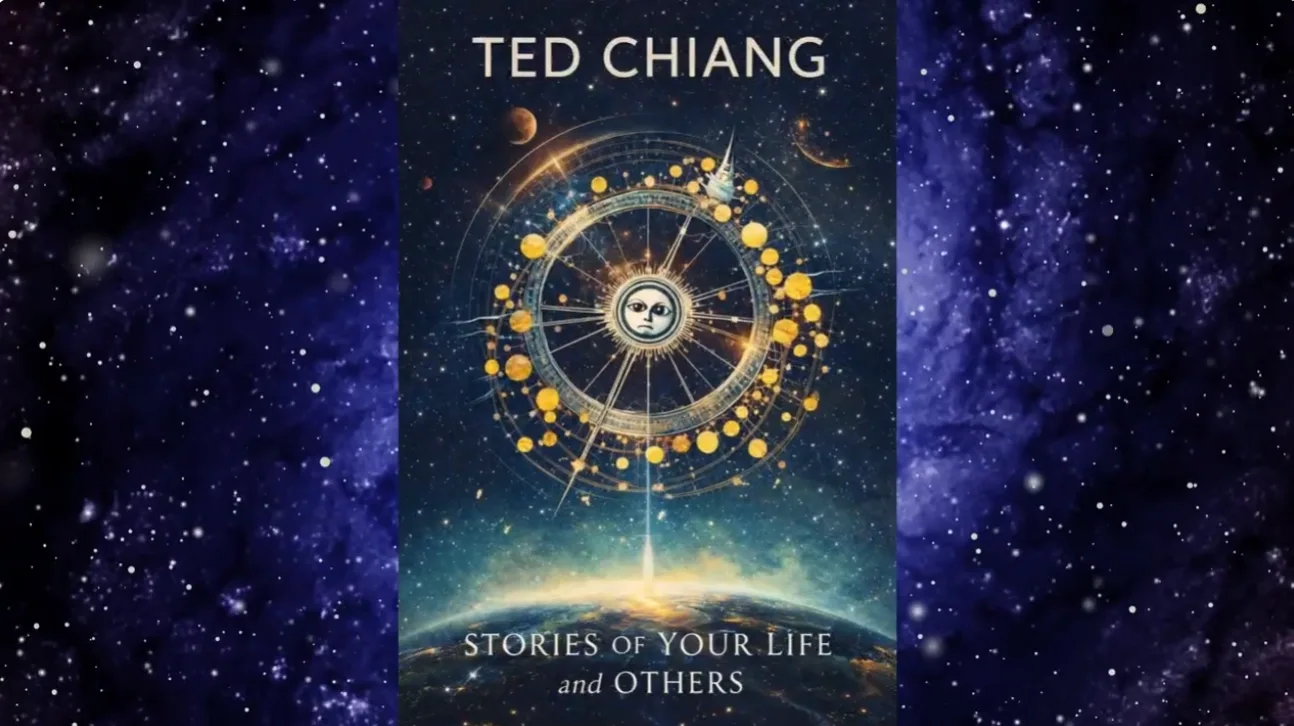
What if learning a new language did not merely change how you described reality—but changed the shape of reality itself?
The Sense of the Mind
Some science fiction asks us to imagine a new technology.
Ted Chiang asks us to operate a new way of thinking.
He introduces a difficult idea, explains it patiently and connects it to something human. Each step feels reasonable. We follow the logic without noticing how far we have travelled from our ordinary understanding of the world.
Then the pieces lock together.
Language changes perception. Cause and effect exchange places. The future becomes something remembered rather than predicted. Free will remains emotionally necessary inside a universe where every event may already be known.
The reader’s mind must expand to hold the apparent contradictions.
That sensation is the Big Stretch: the exhilarating moment when an impossible idea begins to feel not merely imaginable, but almost inevitable.
Ted Chiang and “Story of Your Life”
First published in 1998, “Story of Your Life” centres on Dr Louise Banks, a linguist recruited after alien spacecraft appear around Earth.
The visitors are known as heptapods because of their seven-limbed bodies. Governments and scientists want to understand why they have arrived, what they know and whether they pose a threat.
Louise’s task is more fundamental.
She must learn how they communicate.
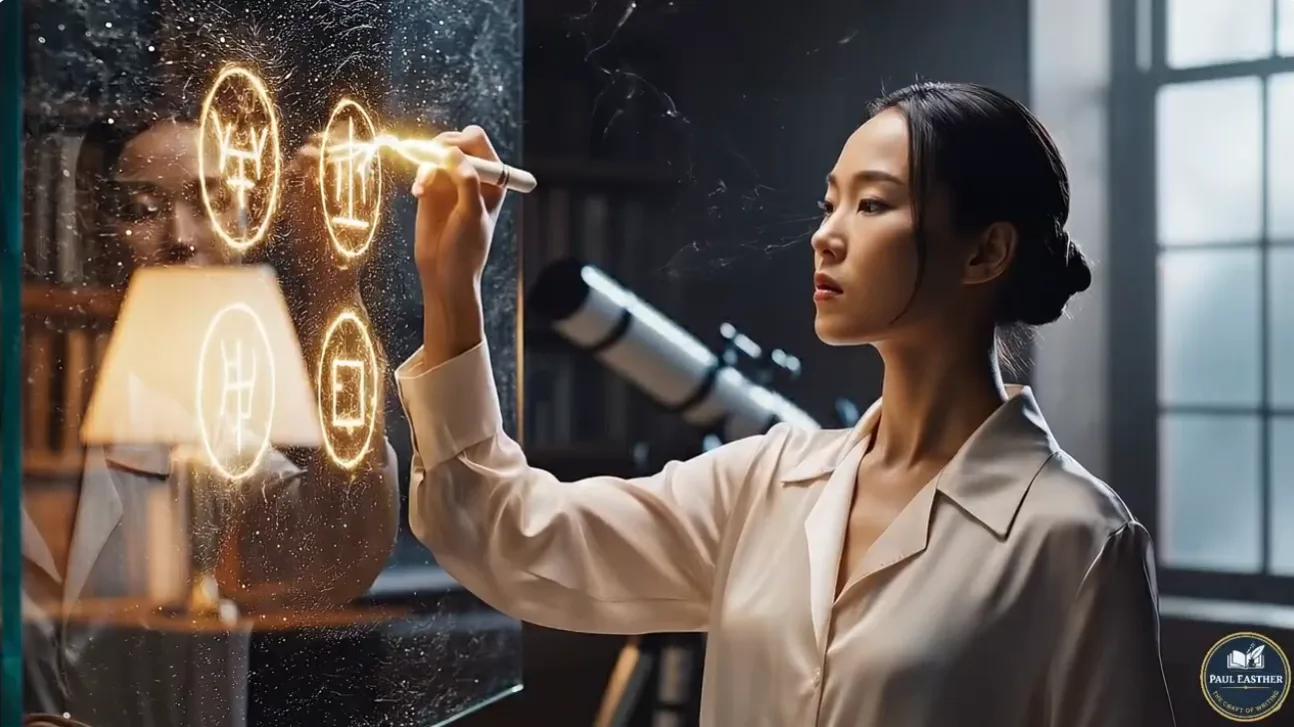
The heptapods possess a spoken language, but their written language is unlike any human writing system. It does not run from left to right, top to bottom or in any other linear direction.
Each written statement appears as a complex circular design.
Its components are interconnected. The beginning and ending do not occupy separate points. Every element must be positioned in relation to the completed whole.
To write the first stroke, a heptapod must already know the entire sentence.
This seems like an interesting linguistic difference.
It becomes the doorway to another experience of time.
The Trigger: A Sentence Written All at Once
Louise recognises the fundamental difference between human writing and the heptapods’ script:
“The heptapods didn’t write a sentence one semagram at a time; they built it out of strokes irrespective of individual semagrams.”
Human beings usually construct sentences in sequence.
We begin speaking before we know the precise form of our final word. We make choices as we proceed, adjusting, correcting and sometimes abandoning the sentence halfway through.
Even when we plan what we intend to say, our language unfolds through time.
The heptapods’ writing does not.
A stroke placed at the beginning may curve or change according to something appearing elsewhere in the completed design. The writer must understand the whole before producing any part.
Imagine drawing a portrait with ink while being forbidden to erase or lift the pen—yet knowing exactly where every future line will eventually meet.
The finished image determines each movement from the start.
The Trick: Building a Ladder into the Impossible
Chiang does not simply announce that the aliens perceive time differently.
He teaches us how such a perception might work.
First, Louise learns individual symbols. Then she notices that their arrangement is not sequential. She begins understanding how the complete sentence controls its individual strokes.
Meanwhile, the physicist working beside her introduces another apparently separate concept: Fermat’s principle.
Light travelling between two points follows the path requiring the least time. From a human, causal perspective, the light begins its journey and encounters conditions along the way.
But the mathematical principle can be described differently. It is as though the light already “knows” its destination and selects the complete route accordingly.
One explanation moves from cause to effect.
The other begins with the whole.
Chiang connects this physical principle to the heptapods’ language. Their writing and their understanding of events share the same structure. They do not experience reality simply as one moment causing the next.
They perceive the completed pattern.
Each idea becomes a rung in a ladder. Linguistics leads to physics. Physics leads to time. Time leads to consciousness. Consciousness leads to free will, love and grief.
By the time Chiang presents the largest idea, we have already climbed high enough to reach it.
When the Structure Becomes the Story
The novella alternates between Louise learning the alien language and scenes involving the daughter she addresses as “you.”
At first, these passages appear to belong to different periods of her life. One story concerns scientific first contact; the other concerns motherhood.
Chiang gradually reveals that the structure is doing more than shifting between past and future.
It is imitating heptapod perception.
Events are not arranged according to the order in which Louise experiences them. They are arranged as parts of one completed emotional design.
The story’s form becomes evidence for its central idea.
We are not merely told what nonlinear time might feel like. We are required to read nonlinearly, gathering moments whose full meaning depends upon scenes we have not yet encountered.
Like a heptapod sentence, the beginning cannot be completely understood until we have seen the end.
And once we reach the end, the beginning has changed.
The Feeling: The Big Stretch
The Big Stretch occurs when several concepts that seemed separate suddenly become one.
The alien symbols are not simply an inventive alphabet.
The physics discussion is not simply technical background.
The unusual chronology is not simply a storytelling trick.
Each element expresses the same underlying question:
What would life mean if you experienced it as a whole?
Our normal understanding of time depends upon sequence. We remember the past, inhabit the present and remain ignorant of the future. Choice feels possible because the outcome has not yet arrived.
Louise begins acquiring the heptapods’ awareness. Future events enter her consciousness with the familiarity of memories.
The reader’s mind pushes against this proposition.
If she knows what will happen, can she change it?
If she cannot change it, are her choices real?
If joy will end in suffering, why choose the path leading towards both?
Chiang does not reduce these questions to a simple answer. He allows determinism and meaningful choice to occupy the same mental space.
The brain stretches to contain them.
Knowing Is Not the Same as Preventing
In most time-travel stories, knowledge of the future becomes a tool.
A character sees what will happen and attempts to prevent it. The drama comes from changing destiny—or accidentally causing the predicted event.
Chiang takes a more radical path.
For the heptapods, knowing the future does not produce a desire to alter it. Knowledge and action belong to the same completed structure. A future event is not a warning sent backwards. It is part of the whole through which consciousness moves.
This can initially resemble helplessness.
Yet Louise’s experience does not feel empty. Her knowledge intensifies the value of individual moments.
Consider hearing a piece of music you know intimately. You remember how it ends, but that knowledge does not make the earlier notes meaningless. You do not demand that the melody change to prove that listening is worthwhile.
The ending gives shape to what comes before it.
The same idea becomes far more difficult when applied to a human life. If we knew that love would bring loss, would we refuse the love—or embrace it more fully because we understood its limits?
Chiang takes an abstract argument about free will and places a human heart inside it.
Why the Science Does Not Smother the Emotion
Complex ideas can make fiction feel like a lecture.
Chiang avoids this because every concept changes something Louise cares about.
Linguistics is not included merely to display research. It transforms her perception.
Physics is not an intellectual ornament. It gives the reader a model for understanding the heptapods.
Nonlinear time is not an ingenious puzzle presented for applause. It changes what it means for Louise to become a mother.
The science and emotion are not separate layers.
They are two descriptions of the same story.
This is why the eventual realisation carries such force. We do not merely understand the proposition intellectually. We feel its cost.
Conceptual awe becomes emotional recognition.
What Writers Can Learn from Chiang
If your story contains a difficult idea, do not begin with its largest claim.
Build a ladder.
Start with something the reader can observe: a symbol, behaviour, physical object or practical problem.
Allow the character to notice one unusual property.
Then connect that property to a second field of knowledge. A biological pattern might resemble a musical rhythm. A legal argument might behave like a computer loop. A family ritual might reveal something about memory.
Let every connection enlarge the original question.
Most importantly, attach the concept to a decision carrying emotional consequences.
Readers may admire an elegant theory, but they remember what the theory costs a character.
You can also allow the structure of the story to demonstrate the idea. If the subject is repetition, repeat a scene with altered meaning. If it concerns unreliable memory, let remembered details change. If it concerns simultaneous time, allow the beginning and ending to speak to each other.
Do not merely explain the concept.
Make the reader perform it.
Your Turn
Choose one impossible proposition:
A person remembers the future.
A language contains no nouns.
A machine answers questions only after its predictions come true.
A photograph shows every consequence of the moment it captures.
Now identify the smallest observable clue that might lead a character towards that discovery.
Explain the clue clearly.
Add a second clue from an entirely different area of knowledge.
Then ask how accepting the idea would alter one deeply personal decision.
The objective is not to make the reader feel ignorant.
Lead them carefully enough that they experience the discovery themselves.
For one extraordinary moment, they should feel that their mind has expanded to accommodate something it could not hold before.
Small beneath the size of the universe.
Yet astonishingly clever for having glimpsed its design.
That is the Big Stretch.
Previously in Writer Mind Games: Vladimir Nabokov and the Beauty Trap.
Next: Octavia E. Butler and the Body Trap.