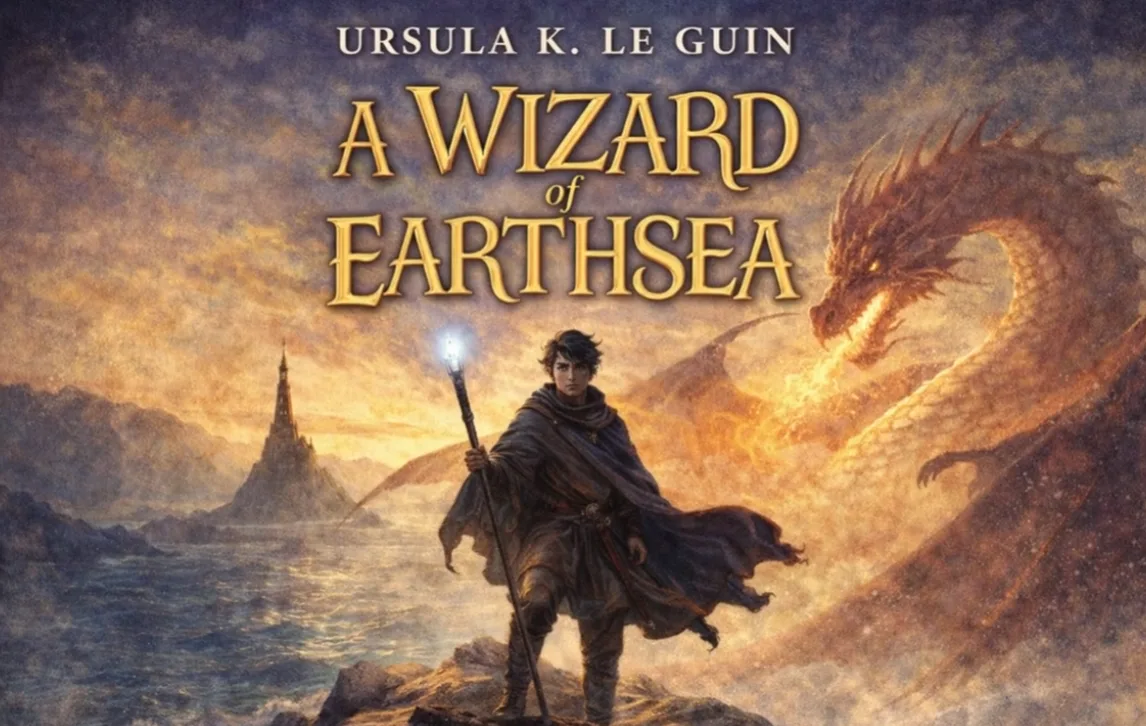
How one simple sentence can make an imaginary world—and your own life—look suddenly different.
The Sense of the Mind
Some writers create excitement by making the world move faster.
Ursula K. Le Guin achieves something more unusual: she makes the reader become still.
Her fantasy contains wizards, dragons, spells and perilous voyages, but beneath the adventure lies a quieter form of magic. A short sentence arrives with the simplicity of an old proverb. You understand every word immediately—and then gradually realise that the idea inside it is much larger than the sentence containing it.
The plot pauses, but the reader’s mind continues travelling.
That is Le Guin’s particular mind game. She does not merely show us another world. She changes the angle from which we look at our own.
Ursula K. Le Guin and A Wizard of Earthsea
Published in 1968, A Wizard of Earthsea follows a gifted boy named Ged who possesses extraordinary magical potential.
Ged is talented, proud and impatient to prove himself. When his ambition is wounded, he attempts a dangerous act of magic beyond his ability. The spell tears open a boundary and releases a shadowy creature into the world.
From that moment, the young wizard who believed power would make him free becomes hunted by something he cannot understand.
At first, this resembles a familiar struggle between hero and monster. Ged must grow stronger, learn more magic and somehow defeat the darkness pursuing him.
Le Guin, however, is preparing a more unsettling revelation.
The enemy is not simply an outside force.
The journey is also taking Ged deeper into himself.

The Trigger: A Candle Casts a Shadow
During Ged’s education, one of his teachers warns him that magic cannot be separated from consequence:
“To light a candle is to cast a shadow.”
Ten words. One ordinary action. One unavoidable result.
The sentence feels instantly true because we can picture it. A candle produces illumination, but the same flame also creates darkness wherever its light is obstructed.
Light and shadow are not independent events. They are born together.
The image opens into a much larger idea. Every exercise of power changes something. Every choice produces consequences beyond the result we intended. Even an act performed for good reasons can create harm, imbalance or loss.
The sentence does not tell us to extinguish the candle. Le Guin is not arguing that action is wrong or that power should never be used.
She is telling us to notice the shadow.
The Trick: Wisdom in a Single Sentence
Le Guin’s language often sounds as though it has existed for centuries.
She does not bury an idea beneath technical explanations or decorate it with elaborate philosophical language. She places something concrete—a candle—beside something symbolic—a shadow—and allows the relationship between them to carry the meaning.
The sentence works because it does not completely explain itself.
The reader must finish it.
We begin by thinking about magic. Then perhaps we think about ambition, leadership, love or parenthood. We remember occasions when helping one person disappointed another, when gaining something meant leaving something behind, or when a decision made with confidence created consequences we never predicted.
Le Guin provides the image. Our own memories supply the evidence.
That is when a line stops being something we have merely read and becomes something we have recognised.
The Shadow Is Not Simply Evil
A lesser story might present Ged’s shadow as a monster that must be destroyed.
Le Guin gives us something more psychologically truthful. Ged cannot become whole merely by attacking everything within himself that frightens or shames him.
His pride released the shadow. Fear then strengthened its power over him. The harder he runs from it, the more completely it controls the direction of his life.
His transformation begins when he stops fleeing.
This reverses the apparent structure of the story. The hunted becomes the hunter—but not because Ged has discovered a more powerful weapon. He has begun to understand that courage may require turning towards what terrifies us.
The shadow represents more than wickedness. It carries the rejected parts of the self: arrogance, anger, fear, shame and the consequences we do not want to claim.
What we refuse to recognise does not disappear.
It follows us.
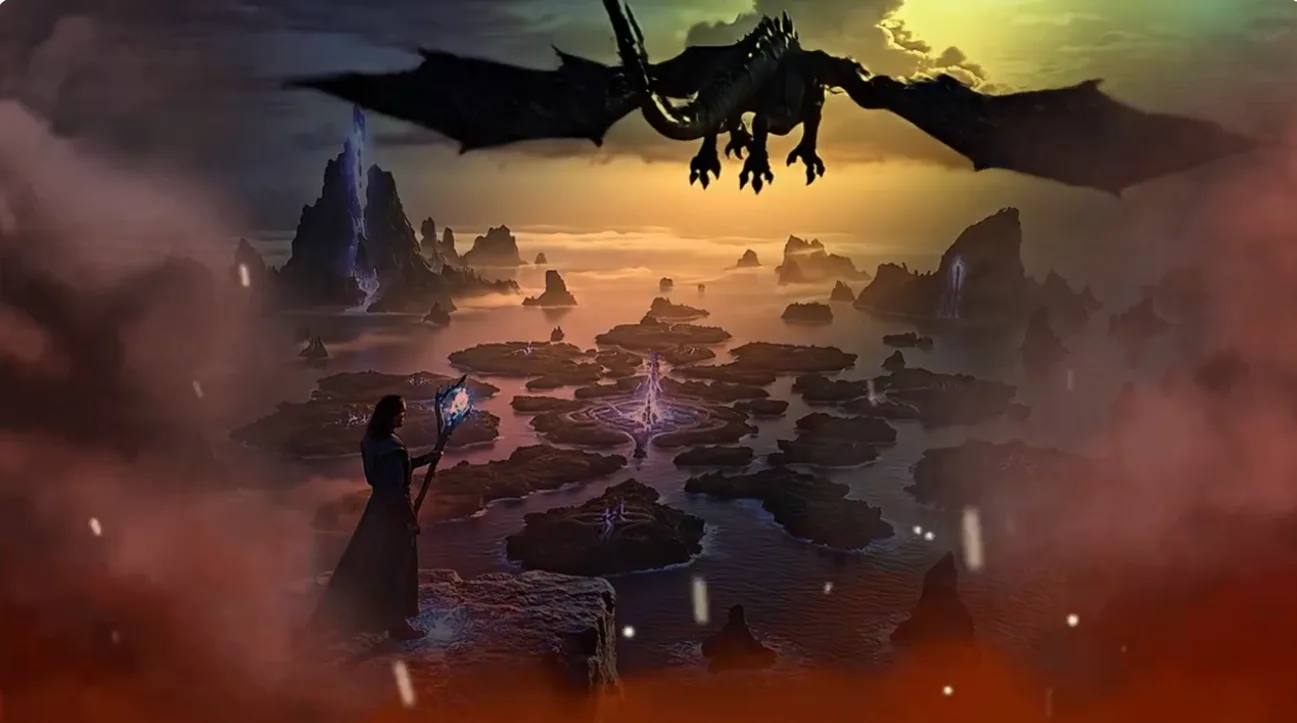
The Feeling: The Big Realization
The effect is not the shock of a sudden plot twist. It is quieter and more expansive.
A connection forms.
The fantasy adventure, the candle, the shadow and Ged’s pursuit of his enemy suddenly become parts of the same idea. The reader steps back from the immediate events and perceives the larger pattern beneath them.
This is the Big Realization.
For a moment, it feels as though the mind has grown spacious enough to hold two apparently opposing truths at once:
Power can achieve wonders, and power can cause harm.
Light is necessary, and light creates shadow.
We can strive to become better without pretending that our darkness belongs to somebody else.
Le Guin does not resolve these contradictions by selecting one side. Her wisdom comes from allowing both sides to remain true.
That produces a peculiar calm. Instead of forcing the world into simple categories—good or evil, strength or weakness, light or darkness—we begin to see balance, relationship and consequence.
The secret is not that darkness can be eliminated.
It is that wholeness requires us to recognise it.
Why Simple Language Can Carry Enormous Ideas
Writers sometimes mistake complexity of language for complexity of thought.
Le Guin demonstrates the opposite.
A profound idea becomes more powerful when the reader can grasp its physical image immediately. Candle and shadow. Word and name. Sea and land. Journey and return.
These elemental images give the prose a mythic quality. They feel older than the characters and larger than the particular events of the story.
But simplicity is not the same as vagueness.
The candle quotation succeeds because it emerges naturally from Earthsea’s system of magic. A wizard’s actions affect the world’s equilibrium. The wisdom belongs to the story before it reaches beyond the story.
Had Le Guin simply paused the narrative to announce a lesson about personal responsibility, the observation might feel imposed. Instead, she lets the philosophy grow out of the rules, dangers and physical details of her invented world.
The reader experiences the meaning before being asked to contemplate it.
What Writers Can Learn from Le Guin
If you want to create this effect, begin with an idea that matters deeply to your story.
Then resist the temptation to explain it abstractly.
Find a physical image that contains the same relationship.
If your story concerns the cost of ambition, what object carries both achievement and loss? If it concerns memory, what familiar thing can preserve something while also changing it? If it concerns love, what action can simultaneously protect and confine?
Place the image inside the action of the story. Let a character use it, encounter it or suffer its consequences.
Then leave enough space for readers to make the final connection themselves.
The aim is not to produce a sentence that merely sounds wise. A decorative proverb can feel like a plaque hung on the wall.
The line must be earned by the story surrounding it.
Le Guin’s candle illuminates because Ged’s entire journey casts its shadow.
Your Turn
Choose the central contradiction in your current story.
Write it in two abstract words: perhaps freedom and responsibility, love and possession, knowledge and danger, or courage and fear.
Now replace those abstractions with one visible image or action.
Keep the sentence short. Remove every unnecessary explanation. Ask whether a reader could understand it literally at first—and discover its deeper meaning a moment later.
Then place it where the character’s choices have already made it true.
The finest sentences do not interrupt a story to deliver wisdom.
They make us realise the wisdom was hiding inside the story all along.
Previously in Writer Mind Games: Fyodor Dostoevsky and the Heavy Guilt.
Next: Haruki Murakami and the Dream Walk.